Burrata Explained: What It Is and How to Serve It Well
Burrata is mozzarella filled with cream. How it is made, how to buy it fresh, why serving temperature matters and what to pair it with in summer.
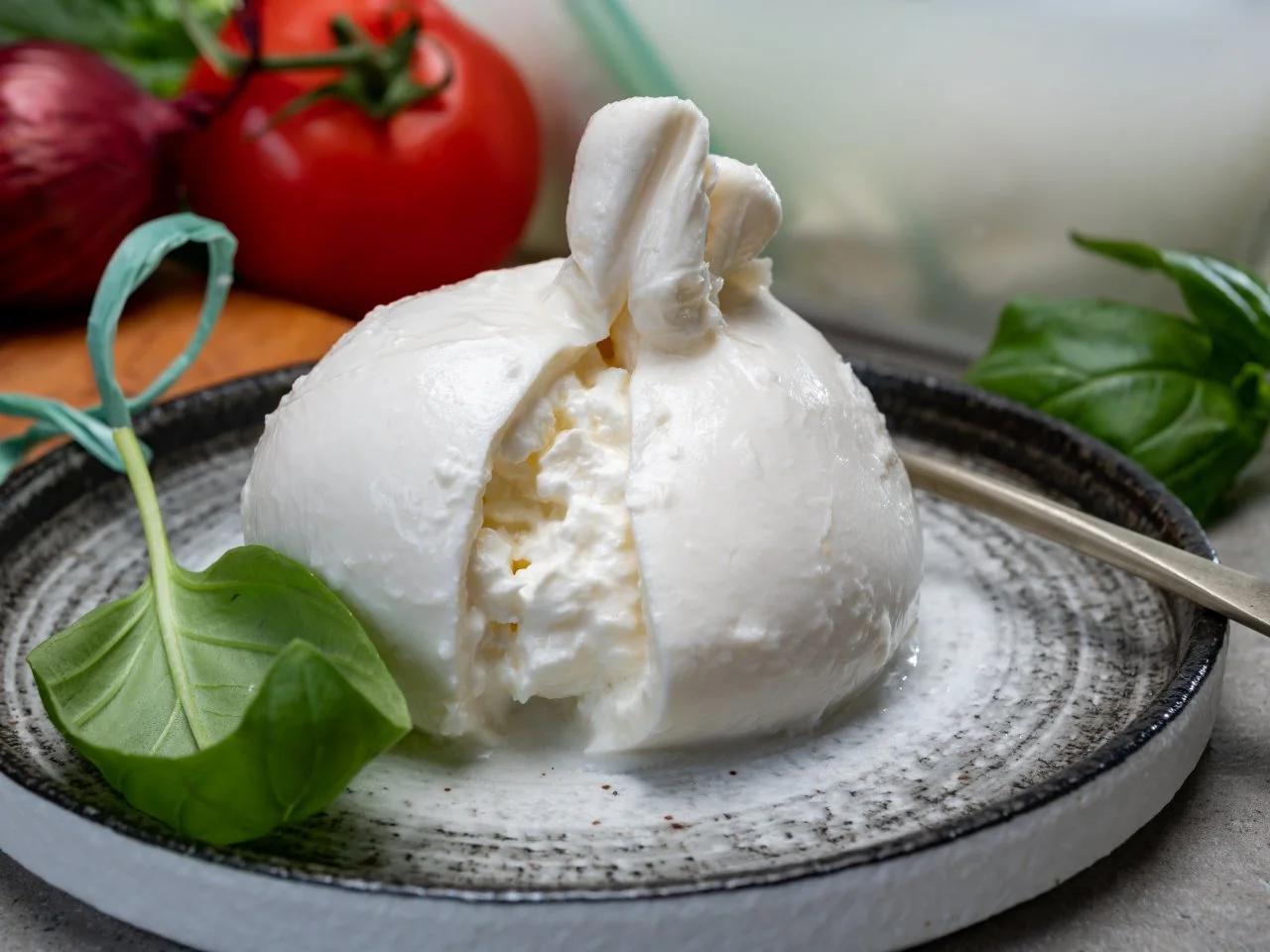
Burrata is fresh mozzarella with a secret inside. The outside is a thin pouch of stretched cow's milk curd. The inside is stracciatella: torn shreds of that same curd steeped in fresh cream. Cut it open and the middle floods the plate, and that flood is the entire reason the cheese exists.
Short version: burrata is a bag of fresh mozzarella filled with cream and shredded curd. It comes from Puglia, it is not aged at all, and it should be eaten within a day or two of being made.
It is not clever cheese. No rind to read, no cave, no five year wait. Which is exactly why buying it well and serving it properly matters more with burrata than with any other cheese you will eat this summer.
Where burrata comes from
Burrata came out of Puglia, the heel of Italy, in the early twentieth century. The story usually told credits a farm near Andria, where cheesemakers wrapped leftover scraps of mozzarella curd in a fresh mozzarella skin along with cream so nothing went to waste. Thrift, then, rather than luxury.
Andria is still the home of the good stuff, and Burrata di Andria holds IGP status, the EU protected geographical indication that sets rules on where and how it is made. The name comes from burro, the Italian for butter.
How burrata is actually made
The process is the same pasta filata (spun paste) method used for mozzarella, right up until the last step.
- Curdling. Cow's milk is warmed and set with rennet.
- Acidifying. The curd is left to develop acidity, which is what lets it stretch later. Get this wrong and it tears instead of pulling.
- Stretching. The curd is worked in very hot water, roughly 85 to 90C, until it turns glossy and elastic and pulls like warm chewing gum.
- Forming the pouch. A piece of hot curd is flattened by hand into a disc and draped over the maker's hand to form a sack.
- Filling. Ragged shreds of the same curd are mixed with fresh cream and spooned in. That mixture is stracciatella, from stracciare, to tear.
- Sealing. The top is twisted and knotted shut, traditionally wrapped in asphodel leaves. The knot is the giveaway that you are looking at real burrata.
No ageing, no cultures doing slow interesting work over months. What you taste on day one is as good as it will ever get.
Burrata against mozzarella
Both start as the same curd. Mozzarella is that curd, stretched and shaped, and nothing else. Burrata is that curd used as packaging for cream. So burrata is richer, softer and sweeter, while mozzarella is springier, milkier and far more useful in a hot oven. Mozzarella holds its shape when heated; burrata collapses into a puddle and loses the contrast that made it worth paying for, which is why it belongs on top of a pizza after it comes out, not before it goes in.
Why burrata goes off so fast
Fresh cheese is mostly water, with no rind, no salt crust and very little acidity. Nothing is protecting it. Add fresh cream, which sours on its own timetable, and the window is genuinely short.
In Puglia the rule is that burrata is eaten the day it is made, or the day after. UK supermarket burrata carries a date a week or two out and will be perfectly safe on that date, but safe and good are different questions. By day five the cream has usually turned slightly sour and metallic and the pouch has firmed up.
So: buy it the day you plan to eat it, keep it in its liquid in the fridge at 4C or below, and never freeze it, because freezing splits the cream and leaves the pouch rubbery. Once it is cut, it is finished.
How to buy burrata at its best
- Look for a knot. A hand tied top means it was formed by hand rather than machine filled. Not a guarantee, but a good sign.
- Buy it sitting in liquid, not vacuum packed dry. The lightly salted water or whey keeps the pouch supple.
- Check the make date, not just the use by date. Good delis will tell you. Anything made in the last 48 hours is a win.
- Feel the weight. A good 125g burrata feels heavy and slack, like a water balloon. Light and taut means a skimpy filling.
- Buffalo milk burrata is tangier and more perfumed, rarer and pricier. Worth trying once.
- Ignore flavoured burrata with truffle paste or pesto pumped into it. Add your own flavour on the plate.
Temperature matters more than anything else
This is the single biggest mistake people make. Burrata served straight from the fridge tastes of almost nothing. Cold mutes dairy fat, and burrata is mostly dairy fat and delicate sweetness. Fridge cold, it reads as rubbery and bland, and people conclude burrata is overrated.
Take it out 30 to 45 minutes before serving, and lift it from its liquid for the last 10 minutes so it drains. Aim for 18 to 20C in the middle. In a warm kitchen, 20 minutes is enough. The difference is not subtle.
Then: put it on a plate whole and cut it open at the table, because the spill is the show. Season it with flaky salt and a hard grind of black pepper, since burrata is deliberately under salted. Pour good peppery olive oil over generously. Serve grilled sourdough or focaccia alongside to mop.
What to eat with burrata in summer
Burrata is a sponge for acid, salt and sweetness. It wants a partner with sharp edges.
Tomatoes. Still the best. Ripe tomatoes at room temperature, salted 10 minutes ahead so they weep, then burrata on top with basil and oil.
Stone fruit. Ripe peaches or nectarines, torn not sliced, with mint, lemon zest and a little chilli. Figs work the same way from late August.
Something salty and cured. Prosciutto di Parma, coppa, or good anchovies on toast alongside. Salt cuts the cream.
Something bitter and green. Grilled courgette, charred spring onions, broad beans or peppery rocket, so it never turns cloying.
Aged balsamic, used sparingly. A few drops of proper thick aged vinegar, not the thin supermarket stuff.
To drink: a crisp Italian white with real acidity. Vermentino, Verdicchio, Fiano or Falanghina all work, and dry rosé is excellent. For ideas further off the beaten track, our unexpected cheese pairings guide applies here too.
How to tell good burrata from bad
Good burrata: a thin pouch that gives under a spoon. Filling that is loose and pours slowly rather than sitting in a lump. It smells of sweet milk and faintly of yoghurt, and tastes clean, sweet and lactic with a butteriness that lingers.
Bad burrata: a thick chewy skin you have to saw through. Filling that is stiff, clumped or barely there. A sour or metallic edge to the cream. A rubbery squeak, which usually means it is old or was frozen and thawed somewhere in the supply chain. If you open one and it disappoints, stir it through hot pasta off the heat with lemon and black pepper and it becomes a decent sauce.
Quick answers
Is burrata just posh mozzarella? No. Mozzarella is the wrapper. The cheese is what is inside: cream and shredded curd. Different texture, different job, different price.
Can you cook with burrata? You can, but you usually should not. Heat destroys the contrast between skin and filling. Add it to hot food off the heat, or on top of a pizza after it leaves the oven.
Do you eat the outside of burrata? Yes, all of it. The pouch is mozzarella, not a rind.
How long does burrata keep once opened? It does not. Eat it within the hour.
Is burrata safe in pregnancy? Burrata made from pasteurised milk and kept properly chilled is generally considered fine, while unpasteurised soft cheeses are usually advised against. This is not medical advice, so check the label and speak to your midwife or doctor.
Is stracciatella the same thing? Stracciatella is the filling on its own, sold in a tub. Cheaper, easier to spoon over things, and no skin.
Found a burrata worth remembering, or one that was a waste of eight quid? Log it in Cheezus so future you buys the right one, and browse the full cheese catalogue while you are there.
Get the app.
Track every cheese you try, scan any label, and find what is good near you. Free on iOS and Android.
Download Cheezus