How to Cut Cheese Properly: A Guide to Every Shape
Wheels, wedges, pyramids, logs, blocks and drums, cut so everyone gets a fair share of rind to centre. Plus which knife to use and why wires exist.
There is one rule that covers almost every cheese ever made, and once you know it you never have to think about this again. Cut cheese so that every portion gets the same ratio of rind to centre as every other portion. That is it. Every shape below is just a different geometry problem with the same answer.
It matters because cheese is not uniform. A wheel ripens from the outside in, so the paste nearest the rind is softer, saltier and more intensely flavoured, while the middle is firmer and chalkier. Slicing the creamy tip off a wedge of brie is not just rude, it means the person after you gets the blandest part. Same story with a blue: the veining sits in the middle, so a bad cut hands one person all the flavour and the next person none.
The knives, and why they are shaped like that
You do not need a set of six. You need two or three, and you need to know why each exists.
- Skeleton knife (the flat blade with holes cut through it). The holes reduce the surface area touching the cheese, so soft, sticky cheeses like brie, Havarti or Taleggio release from the blade instead of dragging behind it. The forked tip is for lifting the slice onto a plate.
- Cheese wire. A wire has almost no thickness, so it passes through crumbly and sticky cheeses without compressing them. The correct tool for fresh goat's logs, feta, mozzarella and young blues. Unwaxed dental floss does the same job in an emergency.
- Chisel or spade knife (short, thick, wedge-shaped). For hard, crystalline cheeses like Parmigiano Reggiano, aged Gouda and Pecorino. You are not slicing, you are splitting: press the point in and lever, and the cheese fractures along its own grain. Trying to slice a 30-month Parmigiano with a thin blade is how knives snap.
- A plain sharp chef's knife handles everything semi-hard: cheddar, Comte, Gruyere, Manchego, Gouda.
- Cheese plane (the flat trowel with a slot). For Scandinavian semi-hard cheeses like Jarlsberg. Useless on anything crumbly.
- Girolle. A spindle and rotating blade invented in Switzerland in the early 1980s for Tete de Moine, which is shaved into ruffled rosettes rather than sliced.
Two practical rules. Cut cold, eat warm: cheese slices far more cleanly at fridge temperature but tastes best at 16 to 20C, so portion it straight from the fridge and let the pieces sit. And give blue its own knife, because blue moulds transfer readily and will turn the cut face of your camembert grey within a day.
How to cut each shape
Small round wheel (camembert, Reblochon, Vacherin, a whole Brie de Meaux)
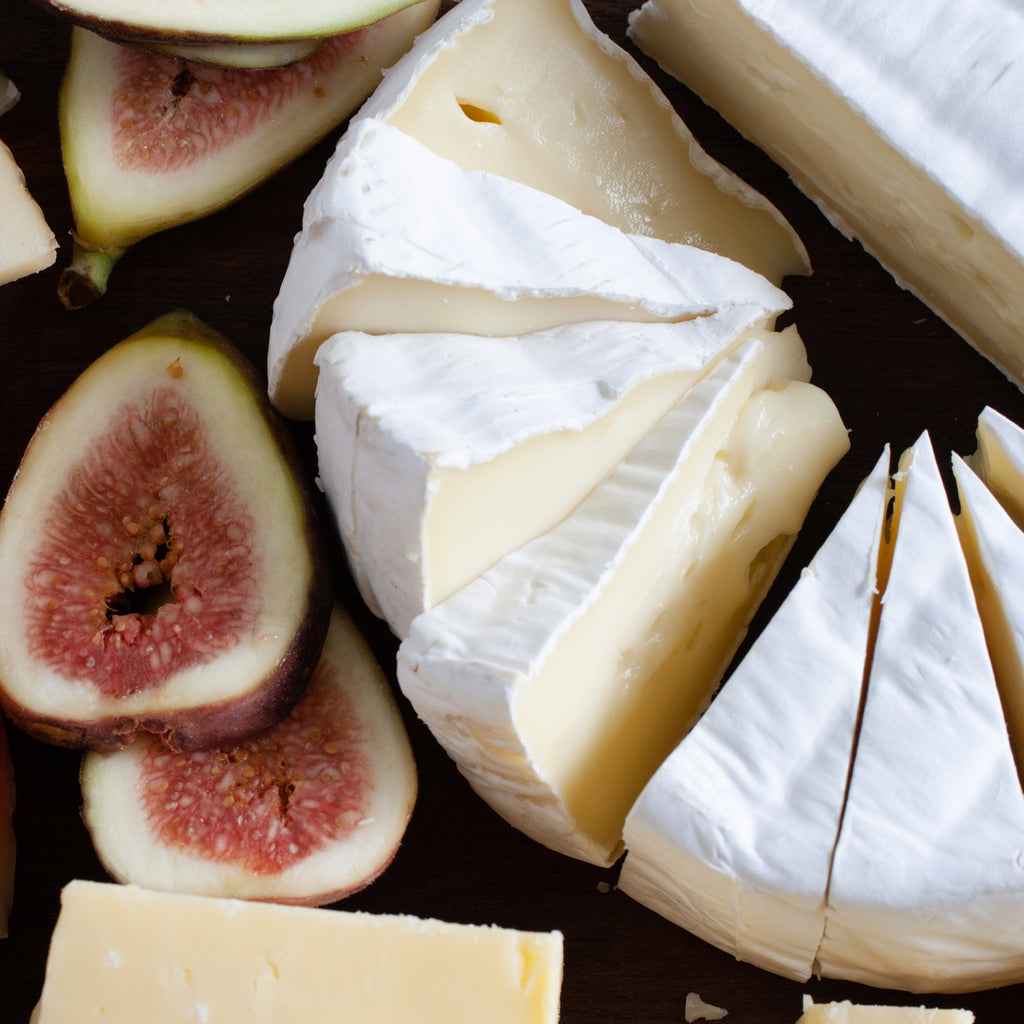
Cut it exactly like a cake. Halve it top to bottom through the centre, halve each half, and keep going until the wedges are the size you want. Every wedge runs from centre to rind and everyone gets an identical slice.
If the cheese is very ripe and running, chill it for thirty minutes first, or cut the top rind off in a disc and serve it with a spoon. The spoon is a deliberate choice, and the traditional way to serve a Vacherin Mont d'Or.
Wedge cut from a large wheel (cheddar, Comte, Gruyere, Gouda)
This is the shape most people get wrong. You have a triangle with a narrow point (the "nose", which was the centre of the wheel) and a wide rind edge. Do not slice across it from the nose backwards, because the first person gets pure centre and the last gets pure rind.
Instead, cut lengthwise: lay the wedge on its side and make cuts running from the nose out towards the rind edge, producing long thin wedges. If the piece is large and tall, halve it horizontally first, then cut each half lengthwise.
Long thin wedge of soft cheese (a slice of brie)
Same principle, and this is where the etiquette lives. Cut parallel to the two long sides, working from the point towards the rind, so each slice includes some tip and some rind. Removing the point in one piece is known as "beheading" the brie, and it is the one cheese-board crime everybody has an opinion about.
Pyramid (Valencay, Pouligny-Saint-Pierre)
Cut down from the apex to the base, straight through the peak, halving it, then quarter each half the same way. Every piece is a slim triangle running top to bottom, carrying some ash-covered surface, some dense top and some softer base.
Log (Sainte-Maure de Touraine, supermarket goat's cheese, fresh chevre)
Cut straight across into discs, using a wire or floss rather than a blade, because a knife will squash the log out of shape. Aim for about 1cm for a board, or 2cm for grilling. Sainte-Maure has a straw running through the middle to hold it together during ageing. Pull it out before slicing.
Rectangular block (block cheddar, feta, halloumi)
Cut a slab off the short end, then cut the slab into fingers or cubes. Blocks come from the middle of a larger cheese, so they are more uniform than a wheel and the rind rule matters less. Just keep the pieces even. For feta, use a wire and expect it to crumble.
Drum or tall cylinder (Stilton, small tommes, Cabrales)
Halve the drum from the top down through the centre, then cut wedges from each half, exactly like a wheel. If the drum is tall, slice a horizontal round off the top first and treat that as a small wheel.
The famous exception is Stilton, which Victorian households scooped from the top with a special spoon. It looks generous and it wrecks the cheese, because scooping dries out the exposed surface and leaves the sides to harden. Stilton makers themselves ask you to cut thin horizontal slices off the top of a half-drum, or to cut wedges.
Very large hard wheels (Parmigiano Reggiano, Grana Padano, aged Gouda)
These are not cut, they are cracked. In Parma a wheel is opened with a set of almond-shaped knives, scored into the rind in sequence and then levered apart so the cheese splits along its own crystalline structure. At home, use the chisel knife: press it into the paste and lever gently to break off irregular chunks, which taste better than neat cubes because the fractured surface is rougher and releases more aroma.
Blue cheeses generally
Cut from the centre outwards so every portion carries some of the heavily veined core and some of the paler, saltier edge. On a wedge of Roquefort or Gorgonzola that means lengthwise slices, never cross-cuts.
Board etiquette in five lines
- One knife per cheese where possible, and always a separate one for blue.
- Take a slice, not the best bit. If the shape of the cheese changes after your turn, you cut it wrong.
- Cut along the length of a wedge, not across the nose.
- Rind is edible on almost everything except wax, cloth and plastic. You do not have to eat it, but do not carve it off and leave the naked cheese behind.
- Work from mildest to strongest so your palate keeps up.
Quick answers
Which knife should I buy if I only buy one? A skeleton knife with a forked tip. It handles soft cheeses well, copes with semi-hard, and the fork tip is genuinely useful for serving.
Should I cut the rind off? Not before serving. Natural, bloomy and washed rinds are edible and carry a lot of flavour. Wax, cloth and plastic coatings are not.
How do I stop cheese sticking to the knife? Cut it cold, wipe the blade between cuts, and use a wire or a holed blade for anything soft. Running the blade under hot water and drying it buys a couple of clean cuts.
How much cheese per person? Around 80 to 100g for a cheese course, and 150g or more if the board is the meal. Three to five cheeses is plenty. More than that and nobody remembers any of them.
Cut it properly, let it come up to temperature, and even an ordinary supermarket wedge tastes better. Browse the cheese catalogue to plan a board, borrow ideas from unexpected cheese pairings, or put the offcuts to work in the ultimate grilled cheese sandwich.
Log what you serve in the cheese tracker and you will notice which styles your friends actually finish.
Get the app.
Track every cheese you try, scan any label, and find what is good near you. Free on iOS and Android.
Download Cheezus