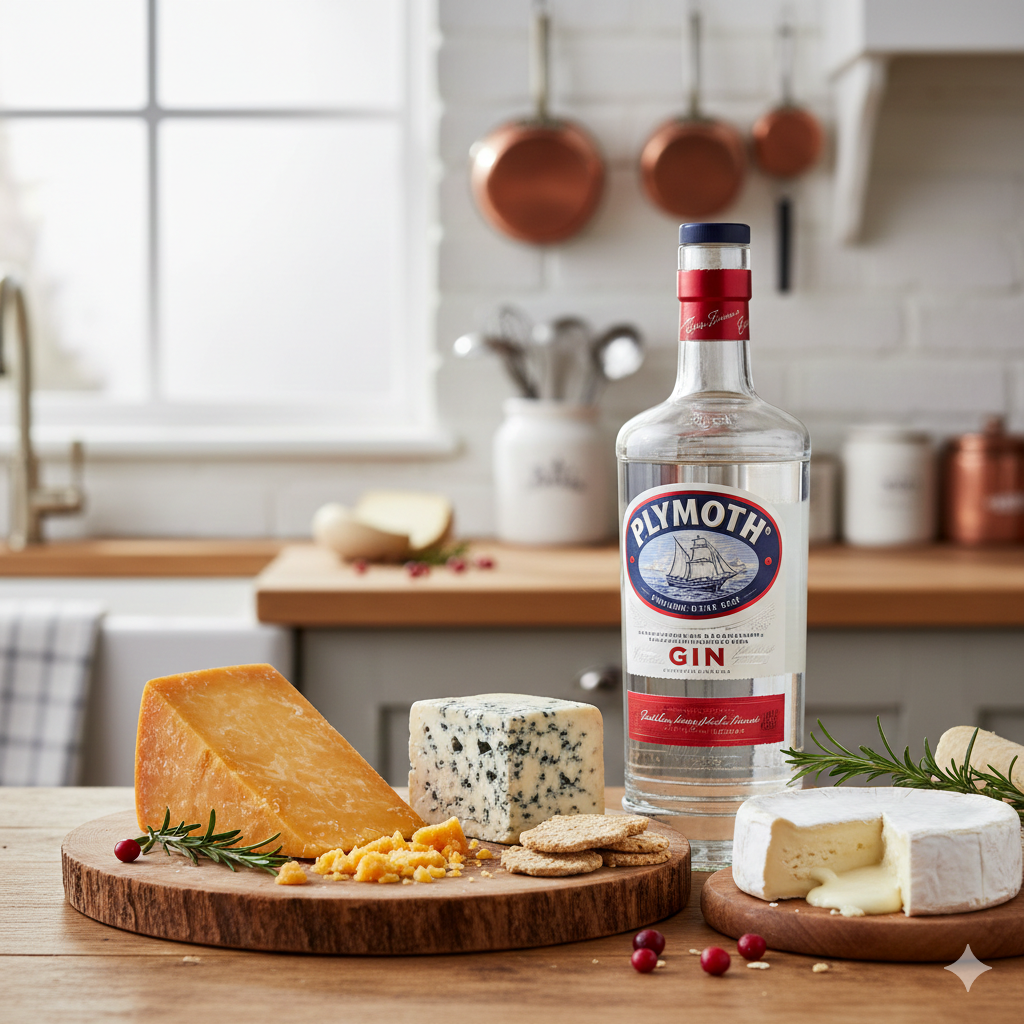
Gin and Cheese Pairing: The Complete Guide by Brand
Which gin brand suits a cheese platter, a full brand and style pairing chart, how tonic changes the match, gin cocktails, and a ready-made tasting flight.
Buy a classic London Dry. Tanqueray, Beefeater, Sipsmith and Gordon's will all handle a mixed cheese platter, because they are built around juniper and juniper is the thing that cuts through fat and salt. If your board leans creamy and bloomy, reach for a citrus-led gin such as Tanqueray No. Ten instead. If it leans blue and pungent, a sweetened Old Tom or a sloe gin will do far more for you than anything bone dry.
That is the short answer. Here is the long one: why the pairing works, a brand by brand table you can take to the supermarket, every gin style matched to cheese, what tonic does to the whole equation, four cocktails and the cheeses they want, and a three gin flight you could buy tomorrow and serve on Saturday.
Why gin and cheese works at all
Wine gets all the attention and most of the failures. Gin is quietly one of the best things you can put next to cheese, and there are real reasons for it rather than vibes.
Juniper is not optional. In UK and EU law, gin must be flavoured with juniper and the taste must be predominantly juniper. There is no such thing as a gin without it. Juniper's essential oil is dominated by pinene, with myrcene, limonene and sabinene alongside, which is why gin reads as pine, resin, citrus and pepper. Those aromatics survive distillation, and they are what slices through a mouthful of butterfat.
Salt suppresses bitterness. This one is properly researched rather than folklore. Sodium reduces perceived bitterness at the taste receptor itself, and knocking back bitterness in a bitter-sweet mixture also makes sweetness read louder. In practice: a salty cheese makes a juniper-heavy gin taste rounder, and the gin makes the cheese taste cleaner. Both sides improve. That single fact underwrites half the pairings on this page.
Acidity cuts richness. A citrus-forward gin does to a triple-crème what a squeeze of lemon does to something fried. It resets the palate instead of piling richness onto richness.
Floral sits beside lactic tang. Fresh goat's cheese is high in lactic acid and low in developed funk, so rose, elderflower and chamomile sit alongside it comfortably. Aggressive juniper against a fresh lactic cheese tends to turn bitter instead.
Sweet loves salty. Sugar softens salt, salt softens sugar, everything lands in the middle. It is why port and Stilton exists, and why sloe gin does the same job.
Above all, match intensity first. Intensity mismatch ruins more pairings than flavour mismatch ever does. Work out how loud the cheese is, pick a gin at the same volume, then decide whether you want the gin to echo it or cut it.
Which gin brand goes with a cheese platter
This is the bit most people actually want. Buy one bottle, buy the cheese next to it, and you are done.
| Gin | What it tastes like | Serve with | Why |
|---|---|---|---|
| Gordon's | Juniper-led with a citrus lift, restrained | Mature Cheddar | Dry enough to cut the fat, not so assertive that it fights back |
| Beefeater | Classic London Dry, pronounced citrus over a firm juniper spine | Manchego, Comté | Nine botanicals including Seville orange and lemon peel, so it cuts and lifts at once |
| Tanqueray London Dry | Uncompromisingly juniper-forward, dry and piney | Extra-mature Cheddar, aged Gouda | Only four botanicals, so the juniper has nowhere to hide. Needs a cheese that shouts back |
| Tanqueray No. Ten | Bright, fresh citrus, softer and more aromatic | Brie, Camembert, triple-crème | Fresh white grapefruit, lime, orange and chamomile. Purpose-built for butterfat |
| Bombay Sapphire | Light, aromatic, spice and citrus led, gentle juniper | Young Gruyère, mild Gouda | Vapour infused rather than steeped, which is why it is so delicate. Do not waste it on a big blue |
| Hendrick's | Cool and floral, cucumber and rose | Young chèvre, Sainte-Maure, ricotta | The cucumber and rose go in after distillation, which is why it is not a London Dry and why it suits fresh lactic cheese |
| Sipsmith | Modern craft London Dry, juniper-true | Aged Cheddar, Ossau-Iraty | A textbook London Dry. If you want the pairing to be about the cheese, this is the bottle |
| Plymouth | Earthy, soft, slightly sweet-edged, creamy | Raclette, young Alpine cheese, mild Tomme | Seven botanicals including green cardamom, made at Black Friars since 1793. Will not bulldoze a subtle cheese |
| Broker's | Classic London Dry with a warm spice thread | Stilton, Roquefort | Nutmeg and cinnamon among ten botanicals. The spice gives blue pungency somewhere to go |
| Monkey 47 | Dense, forest-herbal, peppery, bitter fruit and sweet floral at once | Gruyère, aged Comté | Forty-seven botanicals from the Black Forest at 47 percent. Meets a long-aged Alpine cheese detail for detail |
| The Botanist | Herbaceous, coastal-green rather than fruity | Aged sheep's milk, herb-rolled cheeses | Thirty-one botanicals, twenty-two foraged on Islay. Green on green |
| Gin Mare | Savoury and Mediterranean, olive brine and herbs | Manchego, Pecorino, aged goat's cheese | Arbequina olive, basil, rosemary and thyme. The best savoury-on-savoury match going |
| Roku | Sweet-floral into green tea into a peppery finish | Mozzarella, burrata, mild goat's cheese | Six Japanese botanicals including sakura, yuzu and sencha. Too subtle for anything loud |
| Nikka Coffey Gin | Vivid citrus with a numbing peppery finish | Brie, Taleggio, washed rinds | Four Japanese citrus fruits plus sansho pepper. The acid cuts, the pepper keeps up with the funk |
| Aviation | Soft, low-juniper, lavender and spice led | Fresh chèvre, Brillat-Savarin | The archetypal New Western. Lavender and cardamom beside lactic tang is a gentle, lovely thing |
| Four Pillars Rare Dry | Spicy and citrus-bright, Australian native botanicals | Aged Cheddar, washed rinds | Lemon myrtle, pepperberry leaf and whole fresh oranges in the still. Loud enough for a strong board |
| Malfy con Limone | Overtly lemon-led and sweetened | Mascarpone, ricotta, burrata | A flavoured gin with sugar in it, so treat it as aperitivo. Against fresh creamy cheese it sings |
| Brockmans | Soft, dark berry, almost dessert-adjacent | Gorgonzola Dolce, fruity blues | Blueberry and blackberry lead. Behaves more like a fruit pairing, which blues love |
| Silent Pool | Juniper-driven with a floral-lavender layer and honeyed roundness | Goat's cheese with honey, Tunworth | Twenty-four botanicals including lavender, chamomile and local honey. Honey is the bridge |
| Whitley Neill | Smooth and gently fruity, rounder than a classic London Dry | Wensleydale, mild Cheddar, Gouda | Baobab and cape gooseberry give a soft fruitiness that suits gentler cheeses |
Choosing on price? Under about sixteen pounds, Gordon's and Beefeater are genuinely good cheeseboard gins and need no apology. Around forty, Monkey 47 and Gin Mare give you something worth stopping to talk about. Everything between is preference, not quality.
Every gin style, matched to cheese
If you already own a bottle, work from here. This is the chart to screenshot.
| Gin style | What it brings | Cheeses to reach for |
|---|---|---|
| London Dry | High juniper, pine and resin, bone dry | Aged Cheddar, aged Gouda, Comté, Manchego, Parmigiano Reggiano, Ossau-Iraty |
| Softer, earthier gins | Rounder, earthy, cardamom and citrus | Raclette, young Gruyère, mild Tomme, washed rinds |
| Citrus-forward | Bright acidity, citrus oils | Brie, Camembert, triple-crème, burrata, mozzarella, mascarpone |
| Floral | Rose, lavender, chamomile, elderflower | Young chèvre, Sainte-Maure, ricotta, feta, fresh curd |
| Herbal and savoury | Rosemary, thyme, basil, olive brine | Manchego, Pecorino, aged goat's cheese, herb-rolled cheeses |
| Warm-spiced | Nutmeg, cinnamon, cassia, cardamom, pepper | Stilton, Roquefort, Gorgonzola Piccante, Époisses, Taleggio |
| Old Tom (sweetened) | Residual sugar, rounder body | Salty blues, aged salty hards, anything you would serve with port |
| Navy strength, 57 percent | Very high alcohol, concentrated botanicals | Extra-mature Cheddar, crystalline aged Gouda, Pecorino Romano, strong blues |
| Barrel-aged | Vanillin, tannin, oak | Aged Gouda, Mimolette, aged Cheddar, hard sheep's milk |
| Sloe gin (a liqueur) | Fruit, sugar, tannin, low alcohol | Stilton, aged Cheddar, hard sheep's milk |
| Pink and flavoured | Sugar, fruit flavouring, low juniper | Mascarpone, ricotta, mild goat's cheese, fruity blues |
| Genever | Malt wine backbone, grainy and round | Aged Gouda, Beemster, aged Dutch cheeses |
Five pairings worth building a board around
1. Classic London Dry with aged Cheddar. The most reliable structure in the category. The Cheddar's fat coats the palate, the gin's terpenes strip it back, and the Cheddar's salt softens the juniper so the gin tastes sweeter than it does alone. Use something at least twelve months old and serve the gin neat, cool but not iced.
2. Floral gin with fresh goat's cheese. Hendrick's is the obvious buy and it earns it. Cucumber and rose sit beside chèvre's clean lactic tang rather than arguing with it. Choose a young, chalky log rather than an aged funky one, and a drizzle of honey makes it click.
3. Citrus-forward gin with Brie. Tanqueray No. Ten's grapefruit, lime and orange do exactly what a wedge of lemon does to something rich. Let the Brie come properly to room temperature first, because a fridge-cold bloomy rind tastes of nothing. Sip, bite, sip again.
4. Warm-spiced London Dry with blue cheese. Broker's, nutmeg and cinnamon among its ten botanicals, next to Stilton or Roquefort. The blue's ferocious salt does the bitterness-suppressing work and the spice gives the pungency somewhere to travel. This is the pairing that converts gin sceptics.
5. Herbal gin with Gruyère. Monkey 47 against a well-aged Alpine cheese is a complexity match: forty-seven botanicals meeting a cheese with a year of nutty, brothy development. Not subtle, genuinely thrilling. Small measures.
Three more that everyone else misses
Genever with aged Gouda. Genever is protected to the Netherlands, Belgium and parts of northern France and Germany, and it is structurally different from gin because it blends botanical spirit with malt wine. That malty backbone meets the butterscotch of a three-year Gouda perfectly. If you try one pairing nobody else recommends, make it this.
Sloe gin with Stilton. Sloe gin is legally a liqueur, minimum 25 percent, made by macerating sloes in gin, so it behaves on a board like damson cheese or quince paste. Sweet fruit against salty blue is the port and Stilton trick with a sharper, more English edge.
Savoury gin with sheep's milk. Gin Mare's olive, basil, rosemary and thyme next to Manchego or hard Pecorino. Sheep's milk is nutty and faintly grassy, which meets Mediterranean herbs on the same axis. Add marcona almonds and you have a course.
Gin and tonic with cheese, and how tonic changes the match
Nobody answers this properly, so here it is. Tonic does three things at once. It dilutes the alcohol, so the drink stops stripping the palate and starts refreshing it. It adds sugar, which now competes with the cheese's salt. And it adds quinine bitterness plus carbonation, which lift fat off the tongue mechanically as well as chemically.
The net effect: a gin and tonic is a far more forgiving cheese partner than neat gin, and a much less precise one. Neat gin is a scalpel, a G and T is a palate cleanser. Serve gin neat alongside one great cheese if you want a pairing. Serve gin and tonics if you want a party.
Carbonation is the underrated part, because bubbles physically lift fat, which is why a G and T copes with a triple-crème that the same gin, neat, would flatten. It runs both ways too: since salt suppresses bitterness, eating Comté beside a very dry Indian tonic genuinely makes the drink taste less bitter. Your cheese is seasoning your drink.
| Tonic | Profile | Best with |
|---|---|---|
| Indian tonic | Balanced quinine bitterness, moderate sweetness, strong carbonation | Hard aged cheeses, Cheddar, Comté, Manchego, blues |
| Mediterranean tonic | Herbaceous, rosemary and lemon thyme, less bitter | Sheep's milk, goat's cheese, herb-rubbed cheeses |
| Elderflower tonic | Floral, delicately sweet, gentle bitterness | Fresh goat's cheese, ricotta, mild bloomy rinds |
| Light tonic | Reduced sugar, quinine intact | Delicate cheeses, and any already-sweet pink or flavoured gin |
| Very dry tonic or bitter lemon | Higher acid, low sugar | The richest cheeses: triple-crème, burrata, mascarpone |
Garnish is a pairing lever, not decoration. A citrus twist pushes the drink towards bloomy and fatty cheeses. A rosemary sprig or a ribbon of cucumber pushes it towards fresh and lactic ones. Orange peel or cracked peppercorns push it towards blues.
Gin cocktails and cheese
Dry Martini. Sixty millilitres of gin to ten of dry vermouth, stirred, does almost none of the softening tonic does. It is essentially neat gin with a herbal, saline edge. Pair it with aged hard cheeses: Manchego, Parmigiano Reggiano, aged Gouda. Garnish with an olive and it becomes an outright savoury drink that belongs beside sheep's milk cheese. Never pair a Martini with anything delicate. It will win.
Negroni. Equal parts gin, Campari and sweet vermouth, the highest-bitterness drink here, which is where the salt trick pays off hardest. Blue cheese is the classic and the best; aged Cheddar, Taleggio and Époisses all work. The bitter, sweet and salty triangle is the most satisfying gin cocktail pairing there is.
French 75. Gin, lemon juice, sugar syrup and Champagne. The most cheese-friendly gin drink in existence, because acid and bubbles are the two best fat-cutters in drinks and this has both. Serve it with triple-crème, Brie, burrata and fresh goat's cheese. It is also the right opener for a cheese course, because it resets the palate rather than colouring it.
Gimlet. Gin and lime, sharp and short, undiluted by water or bubbles. Fresh goat's cheese and feta are the targets, where the lime tang meets the lactic tang head on.
How to run a gin and cheese tasting at home
Almost nobody writes this down. Here is the whole mechanic.
How many gins. Three, four at the limit. Gin is strong and aromatic and palate fatigue arrives faster than you expect. Three gins with three cheeses gives nine combinations, which is plenty to argue about.
How much. Fifteen to twenty millilitres of each gin per person, which is a large sip rather than a drink. Allow about thirty grams of each cheese, far less than a cheeseboard. If you are feeding people properly too, our guide to building a cheese board has the fuller quantities.
Glassware. A small wine glass or a copa, not a tumbler. You want a bowl that gathers the aromatics and a rim that concentrates them. Taste at room temperature first, because freezer-cold gin tastes smoother but shows far less.
Order. Lightest to boldest on both sides. Floral or citrus gin, then London Dry, then herbal, navy strength or sloe gin. Cheeses run fresh, bloomy, hard and aged, then blue. Once you go blue you are finished, so put it last.
Method. Smell the gin, sip it, eat the cheese, then sip the gin again. That second sip is where the pairing actually happens, and it is the step people skip. Our guide to tasting cheese properly applies to gin in exactly the same way.
Between rounds. Room-temperature water and a plain water biscuit. Nothing sweet until you have finished, because sweetness resets the palate in the wrong direction.
A three gin flight you could buy tomorrow
- Hendrick's with a young goat's cheese log and a spoon of honey
- Tanqueray or Sipsmith with a twelve month Cheddar and a slice of Comté
- Sloe gin with Stilton and a few walnuts
Well under fifty pounds in sensible sizes, and it covers floral, dry and sweet against fresh, aged and blue. Want a fourth? Add Gin Mare with Manchego between two and three.
Cheeses that already taste of gin
Almost nowhere else mentions these. Gin-washed cheese exists: Jasper Hill's Ginnimere has its rind washed with Barr Hill gin and is wrapped in spruce bark, which pushes it towards resin and forest. Juniper-rubbed cheese does the gin's job for it, as in Pecorino Ginepro. And the gin and tonic cheddar truckles in farm shops each December are pleasant novelty that slot neatly onto a gin board. Browse the cheese database to check what a washed rind actually is before you buy.
A festive gin and cheese board
Gin is a British Christmas drink whether anyone planned it or not, and a gin board is an easy win once everyone has had enough mulled wine. Three cheeses: one fresh, one hard and aged, one blue. Two gins, one dry and one sweet, plus sloe gin as the port substitute. Borrow the accompaniments from the gin itself, so cucumber ribbons, olives, a rosemary sprig, orange and lemon peel, and honey as the bridge between drink and cheese. A hamper is the same job in a box, and the components are always better bought separately.
Common mistakes
Serving the cheese fridge-cold. The biggest error of the lot, and nothing to do with gin. Cold fat carries no flavour. Take everything out an hour before.
Pouring a full drink. A pairing is a sip. A double gin and tonic per cheese ends the evening early and blurs everything after round two.
Putting a delicate cheese against an aggressive gin. A navy strength gin at 57 percent will erase a fresh mozzarella. Intensity first, always.
Assuming every cheese wants a dry gin. Blues want sugar, fresh lactic cheeses want florals. Bone dry is not automatically the sophisticated answer.
Expecting a heavily sweetened pink gin to pair well. Honestly, sweetened gins are the hardest things here to pair, because sugar flattens the palate and leaves the cheese nothing to push against. Serve them with something fresh and creamy and keep expectations modest.
Thinking London Dry means it came from London. It is a production method, not a place, and it can legally be made anywhere in the world.
Frequently asked questions
Which gin brand goes well with a cheese platter? A classic London Dry is the safest single bottle: Tanqueray, Beefeater, Sipsmith or Gordon's. The juniper cuts through fat and the dryness suits aged hard cheeses, which is what most platters are built on. If your board is mostly soft and creamy, choose a citrus-led gin such as Tanqueray No. Ten instead.
What cheese goes best with gin? Aged Cheddar is the most reliable answer, followed by Comté, Manchego and aged Gouda. Hard, salty, mature cheeses give the juniper something to work against, and their salt makes the gin taste rounder. Fresh goat's cheese suits floral gins best, and blue cheese suits anything sweet or spiced.
What cheese pairs with a gin and tonic? Almost anything, which is both the strength and the limitation. Tonic dilutes the alcohol and adds bitterness and bubbles, so a G and T copes with rich, creamy cheeses far better than neat gin does. Brie, Camembert and burrata all work beautifully. Choose a light tonic if the gin is already sweet.
What cheese goes with sloe gin? Stilton, first and foremost. Sloe gin is legally a liqueur rather than a gin, sweet and fruity and lower in alcohol, so it works on a board the way port or damson cheese does. Aged Cheddar and hard sheep's milk cheeses suit it too, particularly at Christmas.
Does blue cheese really go with gin? Yes, and it is one of the best matches available. Blue cheese is intensely salty, and salt suppresses bitterness at the taste receptor, so it softens the juniper and any quinine in the mix. Warm-spiced London Dry gins, Old Tom and sloe gin all excel here, and so does a Negroni.
How many gins should I serve at a cheese tasting? Three, or four at most, with fifteen to twenty millilitres of each per person. Gin is strong and aromatic and palate fatigue sets in quickly. Three gins against three cheeses gives nine combinations, more than enough for an evening.
Go and try one
Pick a single gin and a single cheese from this page tonight rather than building the whole flight at once. The pairings that stick are the ones you have actually tasted, so keep a record of what you taste as you go.
One sensible note to finish on: a tasting is a sip of each, not a round of drinks. Keep the water topped up and enjoy the cheese.
Get the app.
Track every cheese you try, scan any label, and find what is good near you. Free on iOS and Android.
Download Cheezus