Brie vs Camembert: Every Difference That Actually Matters
Brie is milder and wider, camembert stronger and boxed. Compare origin, taste, texture, fat, price, and which of the two actually bakes properly.
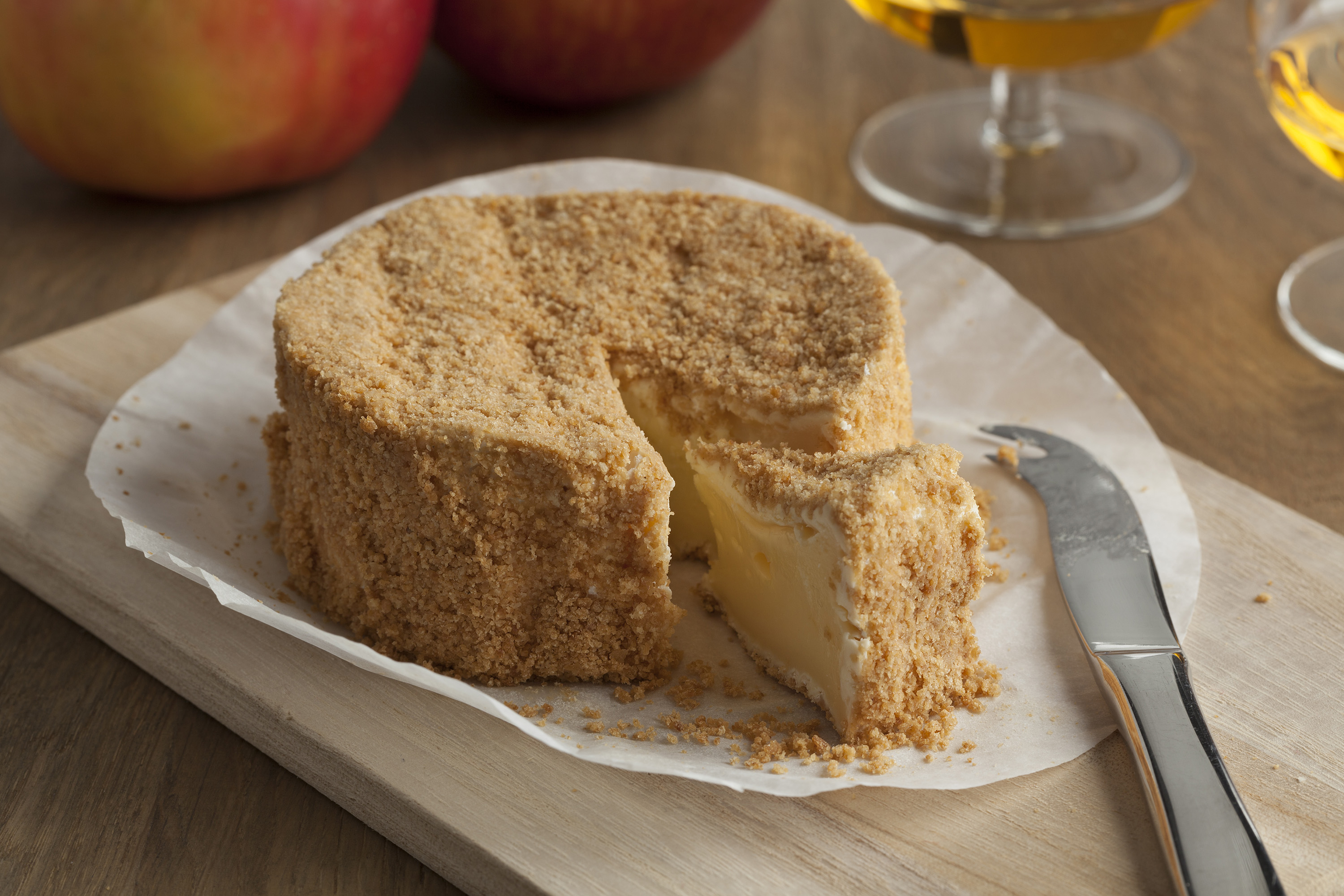
Brie and camembert are both soft, bloomy-rind cows' milk cheeses, and the fastest way to tell them apart is size and strength. Brie comes from Île-de-France in wide, flat wheels up to 37cm across and tastes mild, buttery and mushroomy. Camembert comes from Normandy in a small 250g disc packed in a wooden box, and tastes stronger, earthier and more farmyard. If you want something to spread on a baguette with a bit of jam, buy brie. If you want something to bake whole and dunk bread into, buy camembert.
Where they come from
Brie is the older of the two by centuries. It is named after the Brie region east of Paris, and it has two protected versions: Brie de Meaux AOP and Brie de Melun AOP. Brie de Meaux is the famous one, a raw cows' milk wheel roughly 36 to 37cm wide weighing around 2.5 to 3kg. Brie de Melun is smaller at around 27cm, set slowly with lactic acid rather than pushed along with rennet, and it comes out saltier and more pungent.
Camembert dates from the late 18th century in Normandy, and the protected version is Camembert de Normandie AOP. It must be made from raw milk, ladled into the moulds by hand in several separate layers over a few hours, and ripened for a minimum of three weeks. The wheel is about 11cm across and weighs 250g, which is why it fits so neatly in that thin wooden box.
Here is the part most people miss. Most brie and camembert on UK shelves is neither of those. It is pasteurised, industrially made, and legally allowed to use the words brie and camembert because only the full regional names are protected. Somerset Brie and Président Camembert are perfectly good cheeses, just not the AOP article. If the label says de Meaux or de Normandie, you are getting the traditional recipe.
How they are made differently
Both start the same way. Whole cows' milk, a starter culture, rennet, and the white mould Penicillium camemberti that grows the fluffy rind. The differences are in the handling.
- Wheel geometry. A brie wheel is wide and only 3 to 4cm tall; a camembert is narrow and about the same height. The rind-to-paste ratio is much higher on a camembert, and since the rind is where ripening happens, its flavour develops faster and harder.
- Ladling. Traditional Camembert de Normandie is moulded with a ladle in stages, each layer left to drain before the next goes in. This builds a denser, slightly more elastic paste.
- Ageing. Brie de Meaux needs a minimum of four weeks and most is sold at six to eight. Camembert de Normandie is ready at three weeks, so it hits the shelf younger and keeps developing hard in your fridge.
Taste, smell and texture
Brie is the gentle one. Think warm butter, single cream, raw mushroom and a faint sweetness, with a mild chalky edge from the rind. When it is properly ripe the paste is glossy and silky and slumps rather than runs.
Camembert is louder. Brassica, wet straw, boiled cabbage, mushroom broth, a proper savoury depth and a mineral tang at the end. It smells noticeably stronger in a fridge, and because it ripens fast it can tip into ammonia if you leave it too long. A sharp ammonia hit on opening means it is over the hill. A gentle mushroomy waft means it is perfect.
Texture-wise, brie is smoother and slacker at room temperature. Camembert is denser and more elastic when young, then goes properly molten in the middle as it ripens.
The fat content myth
This one gets repeated constantly and it is mostly wrong. Both Brie de Meaux AOP and Camembert de Normandie AOP have a legal minimum of 45% fat in dry matter, which works out at roughly the same fat per 100g in the finished cheese.
Where fat really diverges is in supermarket brie, because that is where added cream lives. A double crème brie sits around 60% fat in dry matter and a triple crème goes past 75%. If you have ever thought brie was richer than camembert, you were probably eating a double crème.
Price
Approximate UK prices, which move around:
- Supermarket own-label brie or camembert: roughly £6 to £10 per kg
- Camembert de Normandie AOP: usually £5 to £7 for a 250g box
- Brie de Meaux AOP from a counter: usually £25 to £32 per kg
Camembert is the cheapest way into a genuinely protected raw-milk French cheese, because you buy 250g rather than a wedge off a 3kg wheel.
Which one bakes better
Camembert, and it is not close. The wooden box is the whole trick: it holds the sides in while the middle turns to sauce. A brie wheel is too wide and too thin to bake whole, so it spreads flat and collapses.
To bake one properly:
- Take off all the plastic wrapping. Put the cheese back in the base of its box and, if the box has staples, sit the whole thing on a baking tray. Wrapping the box in foil helps it hold together.
- Score the top rind in a criss-cross or cut a shallow lid and peel it back.
- Push in a couple of thinly sliced garlic cloves and some thyme, then a splash of white wine.
- Bake at 180C fan (200C conventional) for 20 to 25 minutes, until the middle wobbles when you nudge the tray.
- Eat it within about ten minutes. It sets again as it cools.
If you only have brie, cut a thick wedge, wrap it in puff pastry and bake it as a brie en croûte instead. The pastry does the job the box would have done.
Brie vs camembert at a glance
| Brie | Camembert | |
|---|---|---|
| Origin | Île-de-France | Normandy |
| Protected names | Brie de Meaux AOP, Brie de Melun AOP | Camembert de Normandie AOP |
| Typical size | 27 to 37cm wheel, 1.5 to 3kg | 11cm disc, 250g |
| Packaging | Cut wedge from a big wheel | Whole, in a wooden box |
| Minimum ageing (AOP) | 4 weeks | 3 weeks |
| Flavour | Buttery, creamy, mild mushroom | Earthy, savoury, brassica, farmyard |
| Smell | Mild | Strong |
| Fat in dry matter (AOP) | 45% minimum | 45% minimum |
| Best for baking | No, unless wrapped in pastry | Yes |
| Best for a board | Yes | Yes, but put it at the strong end |
Getting the best out of either
Take it out of the fridge a full hour before eating. Fridge-cold soft cheese is chalky, muted and a waste of money. Cut wedges from the centre point outwards so everyone gets equal rind and middle, and eat the rind. It is where most of the flavour lives.
For pairings, brie loves fizz, cider and something sweet like fig jam or honey. Camembert wants Normandy cider or a Loire red. For something less obvious, try unexpected cheese pairings or gin and cheese, which suits bloomy rinds better than you would think.
Quick answers
Is camembert just small brie? No. Different regions, different traditional recipes, different moulding technique and different flavour. The size difference is real but it is a symptom, not the cause.
Which is stronger? Camembert, comfortably. If you find camembert too much, a young brie is the softer landing.
Can you substitute one for the other? In most recipes, yes. In a baked cheese, no, use camembert. On a cheeseboard, brie is the safe crowd-pleaser and camembert is the one that gets talked about.
Are they vegetarian? Often, but not always. Camembert de Normandie AOP and Brie de Meaux AOP use animal rennet. Many supermarket versions use microbial rennet and say so on the label. Check before you buy.
Can you eat them when pregnant? UK guidance is to avoid soft mould-ripened cheeses unless they have been cooked until steaming hot all the way through. This is not medical advice, so check with your midwife or GP.
Whichever one wins your evening, log it in the cheese tracker while the taste is still in your mouth, and browse the cheese catalogue to line up the next one.
Get the app.
Track every cheese you try, scan any label, and find what is good near you. Free on iOS and Android.
Download Cheezus