Cheese and Honey Pairing: Which Honey With Which Cheese
Acacia, chestnut, heather, truffle honey and more, matched to the cheeses they actually suit. Plus how much to use and why blue and honey never fails.
Honey and cheese is the cheapest upgrade you can make to a cheeseboard. The principle is simple: salt and sugar make each other taste better, and fat carries both. A drizzle of honey over a salty, crystalline cheese does the same job as salted caramel or bacon on pancakes, except nobody has to cook anything.
The short version: mild delicate honeys like acacia go with fresh and young cheeses. Robust dark honeys like chestnut, heather and buckwheat go with aged, salty and blue cheeses. Match the intensity of the honey to the intensity of the cheese and you cannot really go wrong.
Why sweet and salty works
Sweetness suppresses your perception of bitterness and softens the edge of salt, which is exactly what a strong cheese needs. Blue cheeses carry both a saline hit and a peppery bitterness from the Penicillium roqueforti running through them, and sugar rounds off both at once. The fat in the cheese then holds the honey on your tongue, so the sweetness lingers rather than flashing past.
There is an aroma argument too. Honey is loaded with floral and fruity volatile compounds, aged cheese with savoury and nutty ones, and together they produce a flavour neither has alone. That is why the pairing has survived in Italy, Spain, Greece and Britain for centuries rather than being a modern deli invention.
Honey by variety, and what each one suits
Supermarket blended honey is fine. Single-variety honey is where it gets interesting, and most cost less than a bottle of wine.
Acacia
Pale, almost water-clear, very mild, floral, and slow to crystallise so it stays runny. The most forgiving honey on the shelf. Best with fresh goat's cheese, ricotta, burrata, mascarpone and mild Brie, and the classic Italian partner for Gorgonzola Dolce.
Wildflower
The everyday all-rounder. Medium amber, medium intensity, different every season. Best with mature Cheddar, Manchego, Comté, Gruyère and aged Gouda. If you are buying one jar for a mixed board, buy this one.
Orange blossom
Light, citrus-scented, gently perfumed. Best with ricotta, fresh curd cheeses and mild blues. Ricotta on toast with orange blossom honey is a two-minute breakfast that tastes like a restaurant dish.
Chestnut
Dark, thin, aggressively woody and genuinely bitter on the finish. Divisive on toast and superb with cheese.
Best with: aged Pecorino, Parmigiano Reggiano, Gorgonzola Piccante, mature sheep's milk cheeses. Pecorino with chestnut honey is standard across central Italy, and it is the one to try if you think you already know what honey and cheese tastes like.
Heather
Thick, jelly-like, tawny, faintly smoky and bitter. Scottish heather honey has a texture closer to set jam than syrup. Best with Stilton, aged Cheddar, smoked cheeses and hard sheep's cheeses. A very British pairing and worth seeking out for a Christmas board.
Buckwheat
Almost black, malty, molasses-heavy, a bit barnyard. Not subtle. Best with strong blues, smoked cheeses and very aged Gouda. Use half of what you think you need.
Lavender
Perfumed and floral without being sickly. Best with fresh goat's cheese, Brie and Chaource. Lavender honey over a warm goat's cheese salad is the French bistro version of this pairing.
Manuka
Strong, thick, medicinal, resinous and expensive. Honest assessment: it is not the best cheese honey, because its intensity fights most cheeses rather than complementing them, and you are paying a wellness premium for something you are about to smear on a cracker. If you already own a jar, use it sparingly with a robust aged Cheddar or a firm blue.
Truffle honey
Not a floral variety but a flavoured product, and one of the most reliable crowd-pleasers on a board. Best with Parmigiano Reggiano, aged Pecorino, aged Gouda and Comté: savoury on savoury with sugar in the middle. Check the label, because the cheap ones use synthetic truffle aroma and taste like a scented candle.
Blue cheese and honey, the pairing that never fails
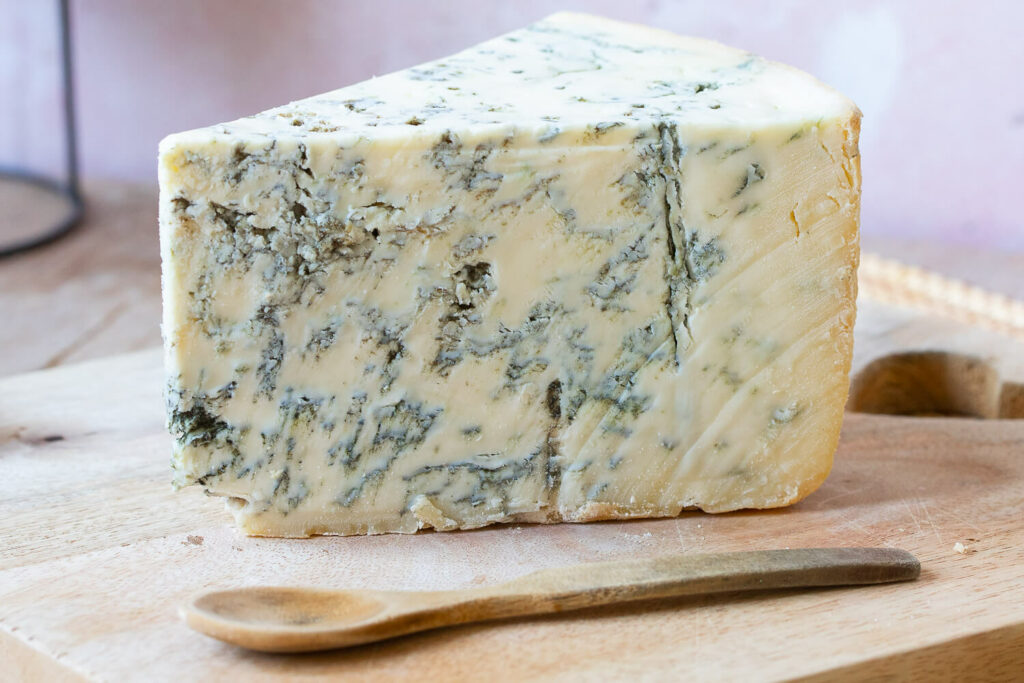
If you take one thing from this, take this. Blue cheese is the saltiest, most bitter, most assertive thing on the board, and honey is the only condiment that meets all three at once. Salt drops back, bitterness rounds off, and the fat of the cheese and the syrup of the honey merge into something close to a dessert.
Three combinations, in order of gentleness:
- Gorgonzola Dolce with acacia honey. Soft, mild, spoonable. The gateway.
- Stilton with heather honey. Firmer, nuttier, more savoury. Very good on an oatcake.
- Roquefort or Gorgonzola Piccante with chestnut honey. Salt, sheep, mould and bitterness at full volume. Not for everyone, unforgettable if it is for you.
Blue cheese has a longer history than most people expect, and the mould was an accident long before it was a technique. That story is in the history of blue cheese.
How much honey to use
Most people massively overdo it. You are seasoning the cheese, not making a dessert.
- Roughly half a teaspoon per 30g portion of cheese.
- Drizzle a thin line across the top rather than pooling it on the plate, so every bite gets some.
- Serve it on the side in a small bowl with a spoon, so people control their own ratio and your Cheddar does not end up soaked.
- If your honey has crystallised, stand the jar in a bowl of hot tap water for ten minutes. Do not microwave it, which drives off the aromatics you paid for.
- Comb honey is worth buying once for the texture. The wax is edible and chewy, and it works best next to a hard cheese that can hold its own.
Hot honey, meaning honey infused with chilli, deserves a mention of its own. It is excellent on mozzarella, halloumi, feta and baked Brie, and it is why hot honey on pizza took over the world. Make your own by warming honey with a pinch of chilli flakes for five minutes, then straining it.
One safety note, and this is not medical advice: honey should not be given to babies under 12 months old, because of the risk of infant botulism. If in doubt, ask a health professional.
Beyond honey: the other sweet things that belong on a board
Honey is the easiest, not the only option.
- Membrillo (quince paste) with Manchego. The Spanish standard, and firm enough to cut into clean slices and stack.
- Damson or quince cheese with mature Cheddar. The British equivalent, sharper and more tannic than membrillo.
- Fig jam with Brie or Camembert. Predictable and still excellent.
- Cherry or apple mostarda with Parmigiano Reggiano. Sweet fruit with a mustardy heat. If you like hot honey, you will like mostarda.
- Maple syrup with aged Cheddar. Standard practice in Vermont and Quebec. Use a dark, robust grade rather than the pale delicate one.
- Date syrup with warm feta or halloumi. Sticky, savoury, excellent.
For more combinations that sound wrong and taste right, we collected a batch in unexpected cheese pairings.
A simple honey-led cheeseboard for four
Three cheeses, two honeys, ten minutes.
- 150g Gorgonzola Dolce with acacia honey
- 150g 18 month Manchego or aged Pecorino with chestnut honey
- 150g fresh goat's cheese with whichever honey is left over
- Walnuts, plain crackers or sourdough, and a few slices of pear
Take it all out of the fridge an hour before serving. Cold cheese is muted cheese, and honey will not spread properly on it either.
Quick answers
What honey goes best with blue cheese? Acacia if the blue is mild and creamy, chestnut or heather if it is salty and strong.
Does honey go with Cheddar? Yes, particularly a mature farmhouse Cheddar. Use wildflower or heather honey, and add a few walnuts.
Can you put honey on baked Brie? Yes, and it is one of the best uses for it. Bake the whole round at 180C for 15 to 20 minutes until it wobbles, then pour honey over and scatter on toasted nuts.
What is the best all-round honey for a cheeseboard? A decent wildflower honey. Enough character for aged cheeses without steamrolling the mild ones.
Should honey be served warm? No, room temperature. It just needs to be runny enough to drizzle.
Next time a combination genuinely works, log it in the app so you remember which honey it was. Start with the catalogue if you are still deciding what to buy, or keep a running record with the cheese tracker.
Get the app.
Track every cheese you try, scan any label, and find what is good near you. Free on iOS and Android.
Download Cheezus