What Temperature to Serve Cheese (And Why It Matters)
Cheese served cold tastes of almost nothing. The target is 16 to 20C. How long each type needs out of the fridge, and how to hold a board all evening.
Cheese straight from the fridge tastes of almost nothing, and that is physics rather than your palate letting you down. Serve cheese at 16 to 20C, which in most kitchens means taking it out of the fridge somewhere between one and three hours before you eat it. Hard, aged cheeses need the longest. Fresh and soft cheeses need the least.
Why cold cheese tastes of nothing
Most of the flavour in cheese lives in the fat. As a cheese ages, its proteins and fats break down into hundreds of aroma compounds, and a large share of those only become volatile (able to lift off the surface and reach your nose) once the fat has softened.
At fridge temperature, around 4C, the butterfat is essentially solid, so the aromatics are locked in place. What is left is whatever your tongue detects directly: salt, a bit of acidity, and a flat impression of dairy. That is why supermarket brie eaten cold tastes like faintly salty butter, and the same wedge two hours later tastes of mushrooms, cream and toasted nuts.
Texture follows the same curve. Cold cheddar snaps and feels waxy. At 18C it bends slightly before it breaks and coats the roof of your mouth. Cold Stilton is gritty and aggressively salty; warm Stilton is creamy, with the salt sitting behind the flavour instead of in front of it.
Given that most of what we call taste is actually smell, serving cheese cold switches off most of what you paid for.
The target: 16 to 20C
"Room temperature" is a useless instruction, because rooms differ enormously. A Scottish kitchen in February and a London flat in August are not the same room. Aim for a real number: 16 to 20C in the middle of the piece, cool to the touch but not cold. A ripe camembert should give under gentle pressure like the pad of your palm below the thumb.
How long each type needs
Times below assume a 4C fridge, a roughly 20C room and unwrapped cheese.
- Fresh cheeses (ricotta, burrata, fresh chevre, feta, cottage cheese): 30 to 60 minutes. Mostly water and mild acidity, so they suffer least from the cold. Burrata is the exception and is genuinely much better at 18C.
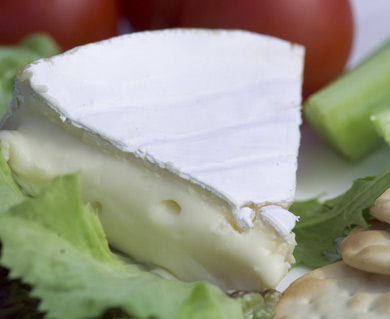
- Soft white-rinded cheeses (brie, camembert, Brillat-Savarin, Tunworth): 1 to 2 hours. The category that changes most dramatically.
- Washed-rind cheeses (Epoisses, Reblochon, Taleggio, Stinking Bishop): 1 to 2 hours. Warming these is exactly as effective on the smell as on the flavour.
- Semi-hard cheeses (cheddar, Gouda, Comte, Gruyere, Manchego): 2 to 3 hours.
- Hard and aged cheeses (Parmigiano Reggiano, aged Gouda, Pecorino, Mimolette): 2 to 3 hours. Low moisture means they warm slowly and hold temperature well.
- Blues (Stilton, Roquefort, Gorgonzola): 1 to 2 hours. Roquefort turns greasy fast above 20C, so bring it out last.
Thickness matters more than category. A whole 250g camembert takes roughly twice as long as a 60g wedge of the same cheese, because heat has to travel to the middle.
How to speed it up without ruining it
- Unwrap it. Cling film and vacuum packing trap moisture against the surface and hold in the stale, slightly sour smell any wrapped cheese develops. Twenty minutes unwrapped, loosely covered with baking paper, transforms the aroma before it has even warmed up.
- Cut it first. Portioning a wedge roughly halves the time it takes to come up to temperature, because you have massively increased the surface area. Cold cheese also cuts more cleanly, so you get tidier slices.
- Use a warm plate, not a hot one. Rinse a plate under warm tap water, dry it, set the cheese on that. It shaves off twenty minutes.
- Do not microwave it, and do not use the oven or a radiator. Microwaves heat fat and water at different rates, so you get molten pockets next to fridge-cold centres. Anything much above 27C pushes fat out rather than softening it.
- Keep it out of direct sunlight. Sun heats the surface far faster than the centre, and light speeds up fat oxidation, which gives cheese a stale, crayon-like off note.
What happens if you overshoot
Somewhere above 22 to 24C, things start going wrong, and some of the damage is permanent.
- Fat weeps out. Those beads of oil on a warm block of cheddar or Gruyere are butterfat that has separated from the protein matrix. Once that has happened the texture stays slightly grainy even after re-chilling.
- Soft cheeses collapse. A ripe brie left in a warm room turns from a cuttable paste into a puddle. It still tastes fine, but you have lost the wedge.
- Blues go greasy and the salt starts to taste harsh rather than balanced.
- Ammonia builds. A brief whiff of ammonia when you first unwrap a bloomy or washed-rind cheese is normal and blows off in open air. Ammonia that gets stronger over an hour on a warm board means the cheese is going past its best.
Hard cheeses can go back in the fridge and be served again with no real loss. Collapsed soft cheeses do not recover their texture, though they are excellent baked or stirred into a sauce.
On safety, both the UK Food Standards Agency and the USDA advise that perishable foods should not sit at room temperature for more than two hours, dropping to one hour above 32C. Hard aged cheeses are among the most robust foods there are, thanks to low moisture, high salt and low pH. Fresh and soft cheeses are far less forgiving, so put those away after two hours. That is general guidance rather than advice for a specific health concern, so check with a health professional if that applies to you.
Holding a board at temperature during a party
The trap with cheese boards is that they get put out at the start and are still sitting there four hours later, sweating gently.
- Serve in waves. Put out half the cheese and keep the rest wrapped in the fridge, then swap it in after an hour.
- Chill the base for soft cheeses. A slate or marble slab given twenty minutes in the fridge sits below room temperature for the best part of an hour, which is enough to stop a ripe camembert running.
- Position matters. Keep the board away from the oven, off a sunny windowsill and away from candles. A kitchen island beside a working hob runs several degrees warmer than the rest of the room.
- Keep formats whole as long as you can. An uncut wedge warms far more slowly than a plate of pre-cut cubes.
- Cover between rounds with baking paper or a tea towel, not cling film pressed onto the cut faces, which makes the surface slimy.
- Outdoors in summer, be ruthless. On a 30C day cheese hits its limit within half an hour. Put out small portions and refresh from a cool box.
Quick answers
How long should cheese sit out before serving? One to three hours, depending on type and thickness. One hour for fresh and soft cheeses, two to three for semi-hard and hard.
Can you put cheese back in the fridge after it has been out? Yes, and for hard cheeses there is almost no downside. Wrap it in waxed or baking paper rather than cling film. Soft cheeses will not regain their shape.
Should cheese ever be served warm? Cooked cheese aside, no. Above about 24C you are past flavour and into fat separation.
Where should cheese live in the fridge? The warmest part, usually the salad drawer or the door, wrapped in waxed paper inside a loosely closed box. A fridge that is too cold and too dry is the main reason cheese from a good shop tastes worse at home.
Does the same rule apply to cooking? No. Grate hard cheese straight from the fridge, while it is firm.
Getting the temperature right is the cheapest possible upgrade to any cheese you already own. Try the same cheese cold and then again ninety minutes later and you will never go back. Browse the cheese catalogue to find something worth the wait, read up on pairings you would not expect, and settle the argument about why some cheeses have holes while you wait.
Log the ones that earn the hour in the cheese tracker.
Get the app.
Track every cheese you try, scan any label, and find what is good near you. Free on iOS and Android.
Download Cheezus