Feta vs Goat Cheese: The Real Differences, Explained
Feta is salty brined sheep's milk cheese, goat cheese is milder and creamier. How they differ in salt, texture and heat, plus when to swap them.
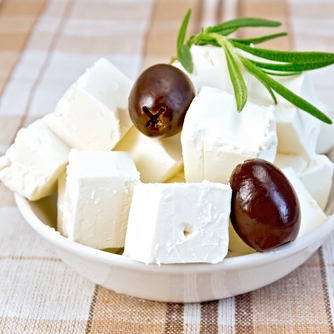
Feta is a brined Greek cheese made from sheep's milk, with up to 30% goat's milk allowed and no cow's milk at all. Goat cheese is made entirely from goat's milk, and in its most common fresh form it is soft, spreadable and lactic rather than salty. They look nearly identical crumbled over a salad, which is exactly why people mix them up, and they behave completely differently the moment salt, heat or a vinaigrette gets involved.
The short version: feta is salty, firm and holds its shape in the oven. Goat cheese is milder, creamier and melts into a soft slump. Reach for feta when you want a salty crumble, goat cheese when you want tang and creaminess.
What feta actually is
Feta has been a Protected Designation of Origin cheese since 2002, and the rules are stricter than most people realise. To be sold as feta in the EU and the UK, a cheese must be:
- Made in mainland Greece or on the island of Lesvos
- Made from sheep's milk, or sheep's milk with a maximum of 30% goat's milk. No cow's milk whatsoever
- Matured in brine for at least two months
- No more than 56% moisture, and at least 43% fat in the dry matter
That moisture ceiling matters more than it sounds. Feta is a wet cheese held together by acid and salt rather than by pressing, which is why it crumbles cleanly instead of slicing like cheddar.
Everything else in the chiller that looks like feta is something else. Cow's milk versions are usually labelled "salad cheese" or "white cheese" in the UK, and they are whiter, blander, springier and often much wetter. Bulgarian sirene and Turkish beyaz peynir are close cousins made to their own traditions. None of them can legally be called feta, and once you have tasted them side by side you will not need the label to tell.
What goat cheese actually is
Goat cheese is not one thing, it is a family. The one most people mean is fresh chevre: the white log, the little pucks, the tubs of soft curd. It is lactic-set, meaning the milk acidifies slowly over 12 to 24 hours with only a trace of rennet before draining, which gives high moisture, gentle acidity and very little salt.
Past that it runs a long way:
- Ash-coated fresh cheeses like Sainte-Maure de Touraine, a log with a rye straw running through the middle, and Valencay, the truncated pyramid
- Aged crottins such as Crottin de Chavignol, which start soft and mild and end up dense, dry and nutty
- Hard goat cheeses including goat gouda and goat cheddar, which behave like their cow's milk equivalents but with a cleaner finish
That distinctive "goaty" flavour comes from three medium-chain fatty acids: caproic, caprylic and capric acid. All three are named after capra, the Latin for goat. Fresh chevre barely registers them. An aged goat cheese is full of them, which is why people who say they hate goat cheese have usually only met the aged kind.
Salt is the difference that ruins recipes
This is the single most useful thing to know. Feta carries roughly 3% salt, which works out around 1,100mg of sodium per 100g. Fresh goat cheese sits closer to 350 to 400mg per 100g. Feta is around three times as salty.
So a straight one-for-one swap wrecks the seasoning of a dish, in both directions:
- Using goat cheese where a recipe expects feta gives you something that tastes flat and slightly sweet. Add a good pinch of salt to the dish and taste again.
- Using feta where a recipe expects goat cheese makes the whole thing aggressive. Cut the salt in the dressing or the filling entirely, then season only at the end.
If your feta is too salty on its own, rinse it under cold water and pat it dry, or soak it in milk for 20 minutes.
Texture, storage and how not to waste money
Always buy feta sitting in its brine rather than vacuum-packed dry. Feta that has been squeezed flat in plastic dries out at the edges and develops a sour, slightly acrid note. In brine, in the fridge, a block keeps happily for weeks. If you run out of brine, dissolve one tablespoon of salt in 250ml of cold water and top the tub up.
Fresh goat cheese is the opposite: it wants to be eaten. A log is at its best within about a week of opening, it softens to spreadable in half an hour on the counter, and it does not freeze well at all.
What happens in the pan and the oven
Feta does not melt. Because the curd is acidified heavily before the cheese is formed, much of the calcium that would normally hold the protein network together has been stripped out. Heat it and it softens, browns and sags, but it never flows. That is a feature, not a fault. It is precisely why baked feta pasta works: a 200g block sat in a dish of cherry tomatoes and olive oil at 200C for 30 to 35 minutes goes soft enough to mash into a sauce while still tasting like feta.
Goat cheese melts, sort of. Fresh chevre slumps into something creamy and very slightly grainy, and it browns beautifully under a grill. A 1cm disc on toasted sourdough, three to four minutes under a hot grill, is the whole trick behind salade de chevre chaud. What it will not survive is a rolling boil. Whisk it into a hot sauce off the heat or it will split and go chalky.
Which one for which dish
| Dish | Use | Why |
|---|---|---|
| Greek salad | Feta, in a slab, not crumbled | Salt and structure are the point |
| Watermelon and mint | Feta | Needs the salt against the sugar |
| Roasted beetroot | Goat cheese | Creaminess balances the earthiness |
| Tarts and quiches | Goat cheese | Melts into the custard |
| Stuffed peppers or courgettes | Feta | Holds its shape through the bake |
| Traybake pasta | Feta | Mashes into a sauce without going oily |
| Dips and cheesecakes | Goat cheese | Blends smooth |
Can you swap them? Yes, with four rules
- One for one by weight is fine in cold dishes such as salads, grain bowls and toppings.
- Always adjust the salt. Up if you are switching to goat, down if you are switching to feta.
- If the recipe needs the cheese to hold its shape through heat, use feta. Goat cheese will collapse.
- If the recipe needs the cheese to go smooth, use goat cheese. Feta will stay stubbornly separate.
Worth knowing: if you want the crumbly, sheepy character of feta without the salt hit, ricotta salata is a closer match than goat cheese. It is a pressed, salted, dried sheep's milk cheese, drier and much gentler.
Nutrition, briefly
They are closer than the marketing suggests. Both land around 265 to 270 kcal and 21g of fat per 100g, with comparable protein. The genuine difference is sodium, where feta is roughly three times higher. Neither is lactose free.
On pregnancy: current NHS advice is that soft cheeses with a white mould rind, which includes many goat cheese logs, should be avoided unless cooked until steaming hot. Pasteurised feta in brine is treated differently because it is not mould-ripened. This is general information rather than medical advice, so check with your midwife or GP.
Quick answers
Is feta a goat cheese? No. It is mostly sheep's milk, with a maximum of 30% goat's milk permitted.
Which is milder? Fresh goat cheese, comfortably. Feta's saltiness reads as strength even though the flavour underneath is fairly simple.
Why does my feta taste bitter? Almost always because it was sold vacuum-packed and dry. Buy it swimming in brine.
Which is better for salads in summer? Feta if the salad is sweet or watery, such as tomato, watermelon or cucumber. Goat cheese if it is bitter or earthy, such as leaves, beetroot or lentils.
Once you know how these two behave, the rest of the fresh cheese cabinet starts making sense. Browse more of them in the Cheezus catalogue, read why cheese has holes while you are at it, and log the feta you actually liked in the cheese tracker rather than trusting your memory at the counter six weeks later.
Get the app.
Track every cheese you try, scan any label, and find what is good near you. Free on iOS and Android.
Download Cheezus