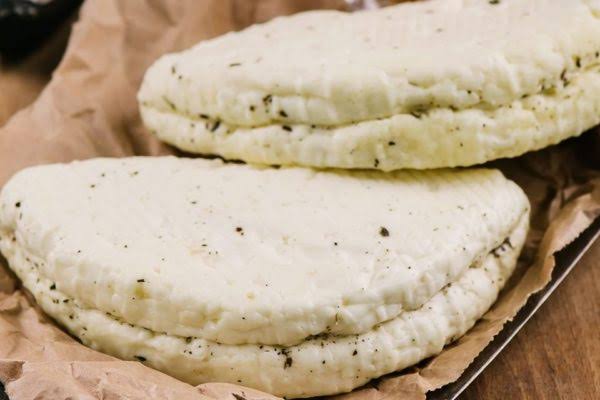
Halloumi and Grilling Cheese: Why It Squeaks and Sizzles
Why halloumi does not melt, how to grill it so it is never rubbery, the salt and soaking question, and the other grilling cheeses worth knowing.
Halloumi does not melt because the curd is cooked in hot whey during the make, which sets the protein network before acid has a chance to break it down. That leaves the cheese with a high pH and its calcium still locked in place, so when you heat it the fat melts and the water evaporates but the protein scaffold holds. You get browning instead of flowing.
That one quirk of manufacture makes halloumi the most useful cheese in your fridge in summer, and it is shared by a family of grilling cheeses most people have never tried.
Why halloumi does not melt
Melting is a calcium problem. In a normal cheese make, starter bacteria convert lactose into lactic acid and the pH falls to roughly 5.0 to 5.4. That acidity pulls calcium out of the casein network, and once those bridges are gone the proteins slide past each other when heated. Mozzarella stretches, cheddar flows, raclette runs off the spoon.
Halloumi is made in the opposite order. Traditional Cypriot halloumi uses little or no starter culture: the milk is set with rennet, the curd cut and drained, then cooked in its own whey at around 90C until the pieces float. That heat denatures the proteins and adds cross-links, welding the network shut while the pH is still high, around 5.8 to 6.2. The cheese is then salted and stored in brine, often folded around a mint leaf, which was originally a preservative rather than a flavouring.
Put that on a hot grill and there is nothing left to loosen. The fat beads on the surface, the water boils off, the proteins and sugars brown, and the block keeps its edges.
Halloumi and Hellim was registered as a Protected Designation of Origin by the EU in April 2021, tying the name to Cyprus. Very good grilling cheese is made elsewhere, it just cannot legally be called halloumi in the EU.
Why it squeaks
The squeak is that same protein network, felt rather than tasted. Halloumi's casein strands are intact, elastic and heavily calcium-bound, and when they rub against tooth enamel they slip and catch in tiny increments. It is the same reason fresh cheese curds squeak.
Two things kill it. Age: as halloumi sits in brine over months it slowly acidifies and the network softens, so mature halloumi is saltier, firmer, crumblier and much less squeaky, closer to a hard grating cheese. Plenty of Cypriots prefer it. Cooling: the squeak is loudest straight off the pan and mostly gone ten minutes later.
How to grill halloumi properly
Nearly all bad halloumi is a technique problem, not a cheese problem.
- Slice it about 1cm thick. Thinner and the outside burns before the middle warms through. Thicker and you get a cold rubbery core.
- Pat it completely dry. It comes out of brine soaking wet, and wet cheese steams rather than browns. Kitchen paper, both sides, properly.
- Get the pan or grill genuinely hot. Medium-high. A lukewarm pan gives you pale, leathery halloumi.
- Oil the cheese, not the grates. A thin film brushed onto the slices gives even contact and stops it welding to the bars. In a good non-stick pan it needs no oil at all.
- Leave it alone. Two to three minutes a side. It releases itself once a crust has formed, and if it is sticking, it is not ready.
- Serve it immediately. Halloumi has a window of about three minutes at its best. This is the one cheese you plate last and eat first.
Put cheese on its own skewers rather than alternating with vegetables, because courgette and peppers need roughly twice as long. In an air fryer, 200C for eight to ten minutes with a shake halfway is reliable.
Marinating does not work: halloumi is too dense and salty to absorb much. Dress it after cooking, while still hot, with hot honey and chilli, lemon and oregano, za'atar, or chilli jam.
The salt question, and when to soak
Halloumi lives in brine and typically lands around 2.5% to 3.5% salt, which is high. Brands vary a lot, and mature halloumi is saltier again.
If yours is too salty, soak it. Cover the sliced cheese in cold water for 30 minutes to two hours, changing the water once, and you will pull a meaningful amount of salt out of the surface layers. Then dry it thoroughly, because you have just made it wetter. Skip the milk-soaking trick: it does little that water does not, and makes the surface likelier to catch.
Worth saying plainly, halloumi is a high salt food, and a 100g portion carries a significant share of the UK's 6g daily salt guideline for adults. That is a reason to treat it as part of a meal rather than a snack. General dietary information, not medical advice.
What to do with halloumi that has gone rubbery
Cooled halloumi does not reheat well in slices, but it works brilliantly cut up. Cube it into a chickpea and herb salad where the chew becomes a feature, dice it into a curry where ten minutes of simmering softens it, or chop it into a fry-up with eggs and tomatoes, roughly how it is eaten for breakfast in Cyprus.
The other grilling cheeses worth knowing
Once you understand why halloumi behaves as it does, a whole shelf opens up.
- Paneer. Indian, made a completely different way: hot milk curdled with lemon juice or vinegar, no rennet and no salt. Acid and heat set the proteins into a firm mesh that will not melt. Milder, softer and unsalted, so it needs seasoning, and it takes a yoghurt-and-spice marinade far better.
- Queso para freir, blanco and panela. Latin American frying cheeses. Mild, salty and firm, sold specifically to be fried. Panela is the softest.
- Queijo coalho. Brazilian, grilled on skewers over charcoal and sold on the beach. Springier and less aggressively salty, and outstanding with lime.
- Leipajuusto, or bread cheese. Finnish, baked so it develops a leopard-spotted brown crust. Squeaks even more than halloumi. Traditionally served with cloudberry jam or dunked in black coffee.
- Kefalograviera, graviera and kasseri. The Greek saganaki cheeses, and not true non-melters. They go gloriously gooey but hold together in a pan, floured first, fried in olive oil and hit with lemon. Kefalograviera is the most reliable.
- Vegan grilling cheeses. Mostly coconut oil and starch. They brown and hold shape, but the chew is springier and the flavour milder.
What to serve with halloumi
Salt wants sweetness and acid. The combinations that work hardest: watermelon, mint and lime; grilled peaches or figs with honey; tomato, red onion and oregano with enough olive oil that the juices become the dressing; hot honey and chilli flakes straight onto the hot cheese. Two thick slices in a bun with harissa yoghurt, pickled red cabbage and rocket also beat most veggie patties.
For drinks, a crisp dry white does the heavy lifting: Cypriot Xynisteri is the obvious answer, Greek Assyrtiko is sharper and works just as well, and a dry rose or cold pale ale both cut through the salt. A gin and tonic is a properly good match too, covered in our gin and cheese pairing guide. For stranger combinations that work, try unexpected cheese pairings.
Quick answers
Can you eat halloumi raw? Yes. It is a fully made, brined cheese, safe straight from the packet. It is just much better cooked, because grilling drives off surface moisture and browns it.
Why is my halloumi rubbery? Either the heat was too low, so it warmed through without ever forming a crust, or it cooled down before you ate it. Hotter pan, thicker slices, eat immediately.
Is halloumi vegetarian? Check the label. Traditional halloumi uses animal rennet, but a lot of supermarket halloumi is made with microbial rennet and clearly marked as vegetarian.
What is the difference between halloumi and paneer? Halloumi is rennet-set, cooked in whey, salted, brined, and it squeaks. Paneer is acid-set, unsalted, softer and milder. Both refuse to melt, for different reasons.
Brands vary far more than people expect. Log what you try in the Cheezus cheese tracker, or browse the cheese catalogue for more grilling cheeses.
Get the app.
Track every cheese you try, scan any label, and find what is good near you. Free on iOS and Android.
Download Cheezus