Can You Eat Cheese Rind? Every Rind, Explained Simply
Most cheese rinds are edible, but not all of them. A rind by rind guide to bloomy, washed, natural, waxed and cloth-bound rinds, and what to always cut off.
Most cheese rinds are edible, and the simplest rule is this: if the rind grew on the cheese, you can eat it. If it was put on the cheese, you cannot. Mould rinds, washed rinds and natural rinds all formed as part of the cheese and are safe to eat. Wax, plastic and cloth are packaging and should come off.
That covers most cases. The rest is where it gets interesting, because edible and enjoyable are not the same thing. Here is every rind you are likely to meet, and what to do with it.
Bloomy rinds: eat them
Cheeses: brie, camembert, Tunworth, Baron Bigod, Chaource, Brillat-Savarin, most fresh goat's cheese with a white coat.
That soft white fuzz is Penicillium camemberti, a mould that is deliberately introduced and then allowed to grow across the surface. It is not an accident and it is not a sign of age. It is the engine of the whole cheese.
The mould feeds on the surface, consuming lactic acid and raising the pH, and releases enzymes that break down the protein in the paste from the outside inwards. That is why a ripe brie is runny at the edges and firmer in the middle. No rind, no runny brie.
Flavour-wise the rind brings mushroom, cooked cabbage and a faint brothy savouriness that balances the butteriness of the paste. Take a slice from the point out to the rind and eat the whole thing in one go, which is what the shape of the wedge is telling you to do.
When to leave it: if the rind smells sharply of ammonia, the cheese is overripe. Airing it for half an hour often fixes it. If it still stings, the rind will taste bitter and there is no saving it.
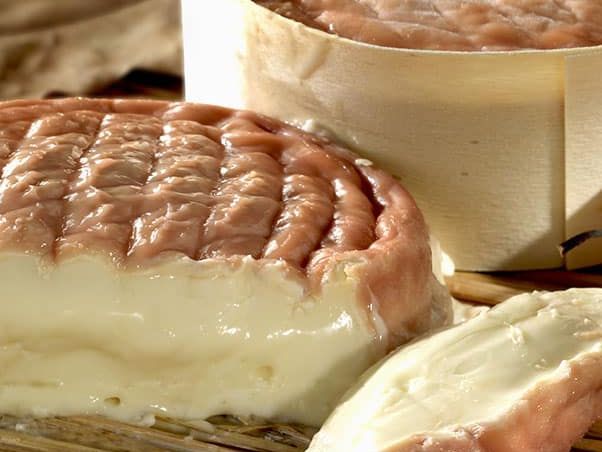
Washed rinds: definitely eat them
Cheeses: Époisses, Munster, Taleggio, Reblochon, Stinking Bishop, Langres, Ogleshield.
These are the orange, pink or tan sticky ones that make your fridge announce itself. During ageing they are repeatedly washed with brine, or with beer, wine, cider or spirits, which encourages Brevibacterium linens to colonise the surface. That bacterium is also what makes feet smell, which explains a great deal.
The rind is where nearly all the flavour lives. The paste alone is mild and milky, and the rind is meaty, beefy and pungent. Eating a washed rind cheese without the rind is a bit like drinking coffee with the coffee taken out.
When to leave it: taste is taste. If Époisses rind is too much for you, scoop the paste with a spoon and no one will be offended. The rind is entirely safe either way. A big washed rind also wants a drink with some sweetness to it, which is where these unexpected pairings earn their keep.
Natural rinds: edible, sometimes worth it
Cheeses: Comté, Tomme de Savoie, Mimolette, Parmigiano Reggiano, Manchego, alpine cheeses generally.
A natural rind forms on its own as the surface of the cheese dries out and airborne moulds settle on it. Depending on the cheese it might be brushed, oiled or brine-washed during ageing. It ends up hard, dry and often grey or brown.
All of it is edible. Whether you want to eat it is another matter.
- Tomme de Savoie: the thick grey-brown rind is genuinely nice, earthy and slightly musty. Try it before you trim it.
- Comté and alpine cheeses: the rind is firm and salty from brine brushing. Perfectly edible, a bit chewy.
- Parmigiano Reggiano and grana padano: far too hard to chew, but do not bin the rind. Drop it into minestrone, a ragù, a risotto or a pot of beans and let it simmer for 30 to 40 minutes. It releases savoury depth into the liquid. Fish it out before serving. Freeze the rinds until you have a use for them.
- Manchego: the criss-cross pattern comes from the moulds used to press the cheese, originally esparto grass belts. The rind is edible but tough and usually cut away.
- Mimolette: the pockmarked grey rind is the work of cheese mites, introduced on purpose. Edible, and most people still take it off.
Waxed rinds: do not eat
Cheeses: most gouda and edam, waxed cheddar truckles, Babybel.
Wax is packaging. It is food-grade paraffin or microcrystalline wax with colouring, applied to stop the cheese drying out. It is not toxic if you accidentally swallow a bit, but it is completely indigestible and tastes of nothing. Cut it off.
The same goes for the red coat on a Babybel and the black wax on a cheddar truckle. If it peels away in one rubbery sheet, it was never part of the cheese.
Cloth-bound rinds: take the cloth off, decide on the rind
Cheeses: Montgomery's, Keen's, Westcombe and Quicke's cheddars, some traditional Lancashires and Cheshires.
Traditional cheddar is bandaged in muslin or calico, greased with lard or butter, and left to age for a year or more. The cloth lets moisture out and lets moulds in. Underneath it, a genuine natural rind develops, grey and brown and slightly furry.
The cloth itself is not food. Remove it. The rind beneath is edible and carries an earthy, cellar-like flavour that some people love. Most cheesemongers trim the outer few millimetres and leave the rest. Taste it and decide for yourself.
Plastic and rindless: not a rind at all
Supermarket block cheddar has no rind because it never had the chance to grow one. It is pressed, vacuum-sealed in plastic and aged inside the bag. The plastic is packaging and the surface under it is just cheese.
Nothing wrong with that, but it is why rindless block cheddar tastes flatter than a cloth-bound one. All the interesting things that happen at a rind never happened.
Leaves, bark and ash
- Cornish Yarg: wrapped in nettle leaves, which soften as the cheese ages and become part of the rind. Edible, and normally eaten.
- Banon: wrapped in chestnut leaves tied with raffia. The leaves flavour the cheese but are not eaten.
- Vacherin Mont d'Or: bound with a spruce bark strip. The bark gives the cheese its resinous note and stays in the box. Do not eat it.
- Ash-coated goat's cheeses such as Valençay and Selles-sur-Cher: that black coating is food-grade vegetable ash. It is edible, it lowers surface acidity to help the rind develop, and it looks superb on a board.
The one rind rule that does matter
There is a difference between a rind and mould that has turned up uninvited. Deliberate moulds have a long and mostly accidental history, as the story of blue cheese shows, but fuzzy blue-green growth on the cut face of a cheese, or on a fresh cheese that should have no rind at all, is not part of the plan.
Standard food safety guidance is to cut at least 2.5cm around and below any visible mould on a hard cheese and eat the rest, because mould cannot easily penetrate a dense low-moisture cheese. On soft cheese, throw the whole thing away, because it can. If you are unsure, throw it away.
Separately, people who are pregnant are generally advised in the UK to avoid soft mould-ripened cheeses and soft blue cheeses unless they are cooked until steaming hot, because of listeria risk. That is a general position and not medical advice, so check with a midwife or doctor about your own situation.
Quick answers
Can you eat the rind on brie? Yes. It is a deliberate mould, it does the ripening, and it carries most of the mushroomy flavour.
Is Parmesan rind edible? Technically yes, practically no. It is rock hard. Simmer it in soup or stock instead and remove it before serving.
Can you eat the wax on gouda or Babybel? No. It is packaging, not food. It will not poison you, but cut it off.
Is the rind where the flavour is? Very often, yes. Ripening runs from the outside in, so the layer just under the rind is the most developed part of the cheese.
Next time you are working through a board, taste the rind before you trim it, then log what you made of it in your cheese tracker and go hunting through the catalogue for the next one.
Get the app.
Track every cheese you try, scan any label, and find what is good near you. Free on iOS and Android.
Download Cheezus