White Crystals in Cheese: What Those Crunchy Bits Are
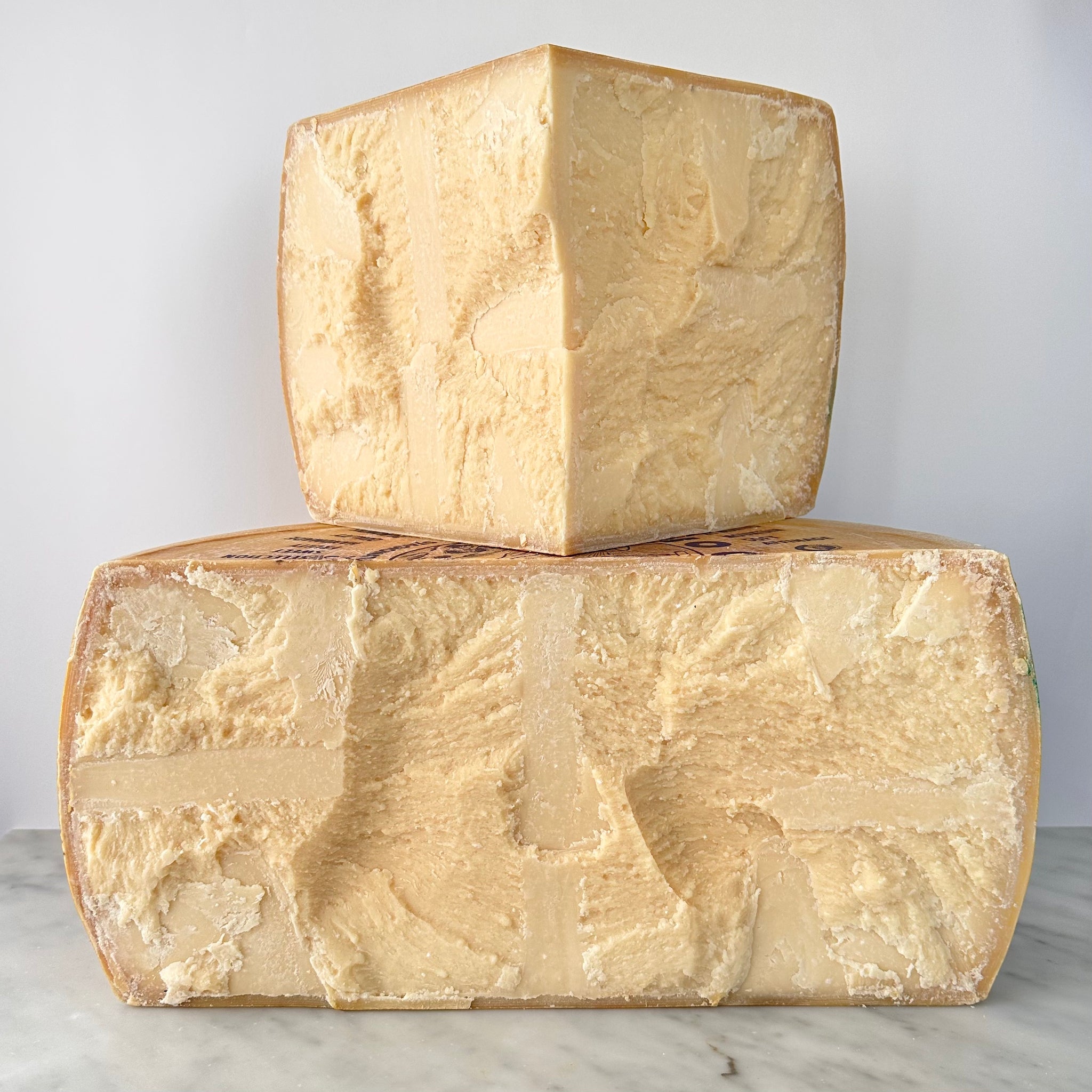
The crunchy white specks in aged Parmesan and Gouda are tyrosine and calcium lactate crystals, not salt or mould, and they signal a properly aged cheese.
Those crunchy white bits in aged Parmesan are crystals, and they are neither salt nor mould. Most of them are tyrosine, an amino acid released as the cheese ages, along with calcium lactate on cut surfaces. They are completely safe to eat and they are one of the best signs that a cheese has been properly aged.
If you have ever bitten into a wedge of 30-month Parmigiano Reggiano or a three-year Gouda and hit a little gritty pop, that is what you found. Cheesemongers get asked about it constantly, usually by someone holding the cheese at arm's length.
What the crystals actually are
There are two common types, and they form in different ways and in different places.
Tyrosine crystals, in the paste
As a cheese ages, enzymes from the milk, the starter cultures and the rennet slowly break the casein proteins down into smaller peptides and then into free amino acids. Cheesemakers call this proteolysis, and it is the engine of flavour development in every aged cheese.
One of the amino acids released is tyrosine, which happens to be poorly soluble in water. Once there is more of it than the cheese's remaining moisture can hold, it drops out of solution and forms hard white crystals inside the paste. Leucine does something similar. They range from the size of a grain of sand up to a couple of millimetres, and because they do not dissolve readily on the tongue, they give that distinctive gritty crunch.
These form deep inside the cheese, not on the surface. Snap open a wedge and you can see them glinting on the fresh face.
Calcium lactate crystals, on the surface
This is the other one, and it is the one that gets mistaken for mould.
Lactic acid bacteria convert lactose into lactate during cheesemaking. Calcium binds to that lactate and, over time, crystallises out as calcium lactate pentahydrate. It shows up as a white, chalky, slightly crusty film on the cut face of a block, and is extremely common on vacuum-packed cheddar. Cold storage, sealed packaging and long maturation all encourage it.
Calcium lactate is softer than tyrosine and dissolves more readily, so it gives a chalky texture rather than a proper crunch. Some producers treat it as a cosmetic defect, which tells you plenty about how harmless it is. They are not worried about safety. They are worried about shoppers who think it has gone off.
Two rarer types exist too: calcium phosphate under the rind of bloomy cheeses, and glassy struvite in fresh cheeses. Neither is a problem.
Which cheeses get crystals, and when
Crystals are a function of time and moisture loss. Long-aged, low-moisture cheeses get them. Wet young ones do not.
- Parmigiano Reggiano. PDO rules require a minimum of 12 months. Crystals become noticeable around 18 to 24 months and are dense and unmistakable at 30 to 36 months.
- Grana Padano. Similar profile, minimum ageing of 9 months, with crystals building through the older grades.
- Aged Gouda. Perhaps the crunchiest of the lot. Noticeable from around 12 months, spectacular at two to four years, with butterscotch and caramel running alongside a proper crackle.
- Comté. Present from about 12 to 18 months, much more pronounced at 24 months and beyond.
- Aged Gruyère, Sbrinz and other Alpine cheeses, and Mimolette Extra Vieille at around 18 to 24 months.
- Extra mature and vintage cheddar, which tends to get both tyrosine in the paste and calcium lactate on the cut face.
- Aged sheep's milk cheeses such as Pecorino Romano, Manchego Viejo and older Ossau-Iraty.
You will not find them in mozzarella, ricotta, young Brie or halloumi. If a supposedly aged cheese has no crystals at all, it is not necessarily bad, but it is probably younger than the label made you think.
Why people mistake them for mould or salt
Both mistakes are reasonable, and both are easy to rule out.
Is it mould? Mould is raised, fuzzy, coloured, sits on the surface and often smells. Crystals are hard, odourless, brush-resistant, and either buried in the paste or spread evenly across a cut face. If a fingernail lifts chalky dust rather than fluff, it is calcium lactate. If it is inside a wedge you have just cut open, it cannot be surface mould at all.
Is it salt? No. Test it yourself: pick a crystal out and put it on your tongue on its own. Salt dissolves almost instantly and tastes obviously salty. Tyrosine stays gritty for ages and tastes of very little, mildly bitter at most. Salt also would not distribute itself in discrete specks throughout the middle of a wheel. It is not sugar either, since a 24-month cheese has essentially no lactose left.
Aged cheese is full of things that look like faults and are not, in the same way that the holes in Emmental look like a mistake and are in fact carbon dioxide doing exactly what it should.
What crystals do to texture and flavour
Here is the nuance most articles get wrong: the crystals themselves are close to flavourless. Tyrosine has almost no taste. A crystal is not making your Parmesan taste better.
What it does do is prove that extensive proteolysis has happened, and proteolysis is exactly the process that produces the free glutamate and other savoury compounds that make an aged cheese taste deep. The crunch and the flavour are siblings, children of the same slow breakdown. Crystals do not cause the flavour, they announce it. That gives you a useful shopping heuristic: visible crystals mean real age, and real age usually means more savoury intensity.
Texturally, crystals come packaged with moisture loss. That is why very old Parmigiano Reggiano is dry and brittle, breaks into shards rather than slicing, and is served in rough chunks. The crunch also gives contrast, a hard little pop against a dense paste, which is a large part of why aged Gouda is so addictive.
How to buy for crunch
- Buy cut from a wheel, not pre-grated. You cannot see crystals in a bag of shreds, and pre-grated cheese is often younger.
- Look at the cut face under good light. Tiny white specks that glint are what you want.
- Ask how old the wheel is. Any decent counter will know, and asking for the oldest wheel currently open costs nothing.
- Serve at room temperature. An hour out of the fridge. Cold flattens the savoury notes the crystals are advertising.
- Break it, do not slice it. With Parmigiano Reggiano, use a short almond-shaped knife to lever chunks apart along the grain. It exposes more crystal-studded surface and looks better than a tidy slab.
If you want the crunch to be the star, put three-year Gouda or 36-month Parmigiano next to something sweet and sticky. Aged hard cheeses are where unexpected pairings work best, because there is enough intensity to hold up against a strong partner.
Can you get rid of calcium lactate?
If the white film on your cheddar bothers you, scrape the cut face or shave a thin slice off. Nothing is wrong with it, but it can look chalky on a board. To reduce it, keep the fridge at a stable temperature and rewrap in waxed or cheese paper rather than leaving cheese in its vacuum pack once opened.
Quick answers
Are the white crystals in Parmesan safe to eat? Yes. They are naturally occurring amino acid and calcium lactate crystals formed during ageing, and entirely edible.
Is the crunchy bit in cheese salt? No. Salt dissolves instantly and tastes salty. These crystals stay gritty and taste of almost nothing.
Why does my cheddar have white spots on the surface? Most likely calcium lactate, especially if the cheese was vacuum packed. Flat, dry and chalky rather than fuzzy, and harmless.
Which cheeses are the crunchiest? Three to four year aged Gouda, 36-month Parmigiano Reggiano, Mimolette Extra Vieille and long-aged Comté.
Do crystals mean the cheese is better? They mean it is older. Older usually means more intense and more savoury, but "better" depends on what you want. A young, buttery cheese is not failing at anything.
Next time you find a crunchy one, note the cheese and its age in the cheese tracker. A dozen entries in, you will know exactly which corner of the catalogue delivers the crunch you are chasing.
Get the app.
Track every cheese you try, scan any label, and find what is good near you. Free on iOS and Android.
Download Cheezus