The Best Cheese for Beginners: Where to Actually Start
A judgement-free guide to the best cheese for beginners: what to try first, how to work up to bolder styles, and exactly what to say at the counter.
Start at the mild end and walk up slowly. The best cheeses for beginners are young Gouda, a mild farmhouse cheddar, proper fresh mozzarella and a slice of Emmental. They are sweet, milky and gentle, with none of the barnyard funk or salty punch that puts people off. Nothing on that list is going to ambush you.
Most people who say they do not like cheese have met about four cheeses in their life, and one of them was a plastic-wrapped orange square on a motorway sandwich. That is not a fair trial. There are thousands of cheeses in the world and they taste about as similar to each other as beer does to whisky.
Here is a route through it, from the gentlest thing on the counter to the stuff that smells like a farmyard in August. Take it at whatever pace you like. You are allowed to stop anywhere.
First, three things that are probably not your fault
Cold cheese tastes of almost nothing. Fat carries flavour, and cold fat is inert. Straight from the fridge at 4C, a beautiful Comté tastes like a rubber eraser. Take cheese out 45 minutes to an hour before you eat it and let it come up to about 18C. This one change does more for your enjoyment than anything else on this page, and it is free.
Ammonia is a fault, not a flavour. If a brie hits you with a sharp, nose-stinging whiff like a cleaning cupboard, it is past it. Someone left it too long in a chiller. That is the shop's problem, not your palate's. Good soft cheese smells of mushrooms, cream and warm cellar.
Rubbery pre-sliced cheese is a texture problem. If it squeaks and bounces, that is not the cheese's fault either. Buy a small piece cut from a wheel instead. It costs less than you think when you only buy 100g.
Level one: the easy start
These are sweet, mild and low in salt. Almost nobody dislikes them.
- Young Gouda (under six months). Sweet, faintly nutty, smooth. The single best starting point.
- Mild cheddar, ideally something cut from a block rather than pre-grated. Milky and clean.
- Fresh mozzarella, the kind sitting in liquid rather than the shrink-wrapped grating stuff. Barely a flavour at all, mostly a lovely texture.
- Emmental or Jarlsberg. Sweet, mellow and full of holes. If you have ever wondered where those holes come from, we wrote about why cheese has holes.
- Wensleydale or a young Lancashire. Crumbly, lactic, slightly lemony. Very British and very easy.
Level two: a bit more to say for itself
Now you want flavour without funk. Aged cow's milk cheeses are the sweet spot.
- Comté, aged 12 to 18 months. Nutty, brown-buttery, a little fruity. It is one of the most popular cheeses in France for a reason.
- Gruyère. Similar territory, slightly saltier and more savoury.
- Aged Gouda, 18 months or more. Butterscotch, toffee and those crunchy little crystals that people get excited about. Those crystals are tyrosine, an amino acid that forms as the cheese ages, and they are a sign of a well-matured wheel rather than a defect.
- Mature cheddar from a traditional maker such as Montgomery's, Keen's or Westcombe. Deep, savoury, slightly fruity, nothing like supermarket "extra mature".
- Manchego semi-curado. Spanish sheep's milk aged around three months. Buttery and gentle, with a mild nuttiness.
Level three: soft, bloomy and creamy
The white fuzzy-rinded cheeses. This is where people usually get nervous, and usually for no reason.
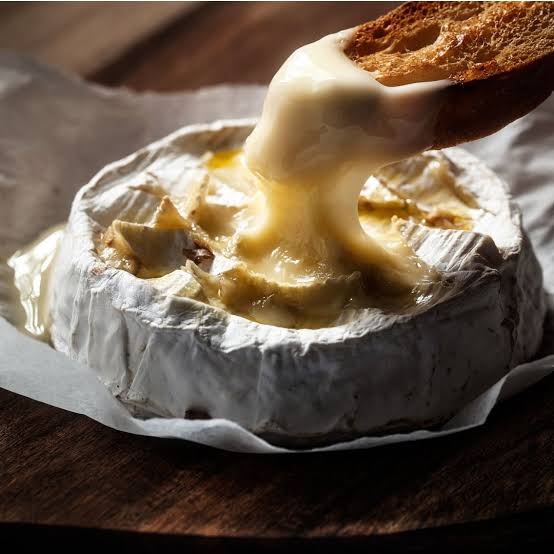
- Brie and Camembert. Buttery, mushroomy, mild when young and much stronger when ripe. Buy a small whole one rather than a wedge if you can, because a cut wedge ripens unevenly.
- Brillat-Savarin, a triple cream. Roughly 75% fat in dry matter. It tastes like slightly savoury clotted cream and it converts sceptics.
Yes, eat the rind. It is edible on every bloomy cheese, and it holds a lot of the flavour. If you genuinely do not enjoy it, leave it. Nobody is checking.
Level four: tang, goat and sheep
Goat's cheese is where a lot of people bounce off, and the reason is chemical. Goat's milk contains caproic, caprylic and capric acids, which are the compounds behind that distinctive tang. Some people love it, some find it soapy. Both are legitimate.
Start soft and young rather than aged, because the tang concentrates with age.
- Fresh goat's log (chèvre). Bright, lemony, light.
- Sainte-Maure de Touraine. An ash-coated log from the Loire, still fairly gentle when young.
- Garrotxa, a Spanish goat's cheese. Firm, mild and much less goaty than people expect, with a mushroomy grey rind.
- Ossau-Iraty, a Basque sheep's milk cheese. Rich, nutty and calm. A brilliant introduction to sheep's milk if goat is not for you.
Level five: blue and washed rind
The two categories with the worst reputations and the biggest rewards.
For blue, do not start with Roquefort. Start with Gorgonzola dolce, which is soft, sweet, spoonably creamy and barely spicy. Then try Stilton, then Roquefort once you have the taste for salt and sharpness. Blue cheese has a long and genuinely strange past, which we covered in the history of blue cheese.
For washed rind, the golden rule is that they smell far worse than they taste. Taleggio is the gateway: it smells like a gym bag and tastes like sweet, fruity cream. Work up to Époisses only when you are ready to commit, because your fridge will know about it.
What to actually say at the cheese counter
Cheesemongers are, almost without exception, delighted when someone admits they know nothing. It is the shoppers who pretend to know everything who are annoying. Useful sentences:
- "I'm new to this. Could you give me something mild and nutty?"
- "What's eating really well today?"
- "I liked [name a cheese]. What's near that?"
- "Could I try a bit of that one?" Tasting before buying is completely normal.
- "Just a small piece, enough for two people." About 50g per person for a snack, 30 to 40g per cheese per person for a board.
- "I've got about a tenner to spend." Naming a budget is not embarrassing, it is helpful.
Buy small and buy often. Three 80g pieces teach you more than one 250g block, and cheese does not improve in your fridge.
You are allowed to not like things
This matters more than any list. If you try Roquefort and it tastes like salty regret, that is information, not failure. Nobody's palate is universal, and plenty of people who work in cheese have styles they quietly avoid.
What is worth doing is trying the same style twice, from different makers, before you write it off. A supermarket goat's log and a properly made Crottin de Chavignol are only loosely related. One bad example is not a verdict on a whole category.
The other thing worth doing is writing down what you thought. Three words is enough: "salty, crumbly, liked it". After twenty cheeses you will start to see your own pattern, and that pattern is far more useful than anyone else's recommendations.
Quick answers
What is the mildest cheese I can buy? Fresh mozzarella or ricotta, then young Gouda if you want a bit more flavour.
Is the rind safe to eat? On bloomy cheeses like brie and on washed rinds, yes. On hard cheeses like Comté the rind is edible but tough and often unpleasant. Wax and cloth are not for eating.
How much should I buy? For a board, 30 to 40g of each cheese per person. For eating on its own, 50g per person.
How long does cheese keep? Wrap it in waxed or greaseproof paper rather than clingfilm so it can breathe. Hard cheese lasts a few weeks, soft cheese around a week once cut.
Is expensive cheese actually better? Often, but not always. Price mostly reflects ageing time and small-scale production. A £5 piece of properly aged cheddar beats a £12 novelty every time.
Once you have found a few you like, the fun part is chasing the connections: this one is sweet like that one, this one is a saltier version of the thing you had last month. Browse the full cheese catalogue to see what is out there, and use the cheese tracker to log what you taste so your own map builds itself.
Get the app.
Track every cheese you try, scan any label, and find what is good near you. Free on iOS and Android.
Download Cheezus